
Where Our Political System Is At
“Politicians are like diapers. They both should be changed often, and for the same reason.”
― Unknown
Our 18th Century Political System Needs a Major Update
Would you buy a home built in the 1700s that hasn’t had several major remodels since then? Probably not, unless you wouldn’t miss indoor plumbing.
In the nearly 250 years of its existence, the Constitution has only been updated with amendments 27 times. That includes the first ten, enumerated in the Bill of Rights and ratified in 1791. That means, as of 2025, there have been just 17 Amendments to the Constitution in the last 234 years, or once every 13 years. By comparison, Apple updates its iPhone operating system an average of once per month.
That is not to suggest that the manner in which our government functions should be changed very often. But since the Laws laid out in the Constitution impact the lives of every American, it stands to reason that they should be periodically updated to reflect the evolving attitudes and developing challenges of the times in which we live.
While there are numerous explanations for why our government has become so dysfunctional, two major reasons are the stranglehold that special-interest groups hold over lawmakers, and the extreme levels of partisanship we see practiced all the time. The American people suffer the effects of both every single day.
Politicians for Sale or Lease
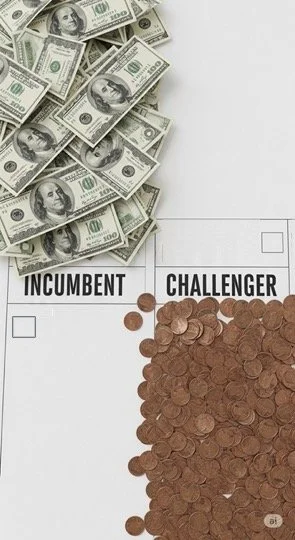
Today, we have a Congress that devotes itself almost exclusively to the desires of the special interests who fund their campaigns and, sometimes, even their personal lifestyles. Nothing gets done in Washington until every key interest group has been satisfied. Legislators do not take into account either the good of the country or its citizens. A 2017 study revealed just how much lawmakers cater to the ultra-wealthy, large corporations, and special interests. The needs of the country and its people are mostly nonfactors. The notion of requiring Members of Congress to wear sponsorship logos like race car drivers may not be serious, but it speaks to the disproportionate amount of power that special-interest groups hold over them.
If we don’t want government driven by special interests, we need to stop voting for those so addicted to their contributions and the other goodies they dole out, such as free luxury travel, tickets to sold-out sports and entertainment events, future job opportunities, and more. American politics reeks of corruption. Even some members of the Supreme Court have come under fire for their own ethical practices, such as accepting expensive gifts, travel, accommodations, loan forgiveness, and more, at times not even reporting these as required.
Meanwhile, the Supreme Court’s rulings on money in politics, including the 2010 Citizens United v. Federal Election Commission decision, have created a wild-west, anything-goes atmosphere in campaign fundraising. Among other consequences of that particular ruling are unlimited contributions of soft money to politicians, as well as dark money, whose sources can’t be traced since they’re made anonymously or washed through multiple entities.
Since most current lawmakers came of age in this ethically compromised era of political fundraising, it will take new generations of candidates willing to forgo such practices in order to get us to a better place politically. That’s why it’s so important to have at least a basic understanding of money in politics, and to know who’s financing the politicians and ballot measures we vote on.
You can learn more about all this under the Money in Politics topic.
The Toxic Brew of Money in Politics and Noncompetitive Elections
More than $14 billion was spent on 2020 Federal election contests, more than twice the amount spent in 2016, according to OpenSecrets.org. A similar but slightly smaller amount was spent in the 2024 elections. Up to that time, nine of the ten most expensive Senate races, and five of the ten most costly House races, also took place in 2020.
In both elections, huge amounts were spent by groups not required to fully disclose the sources of their contributions. We’re a long way from the time when campaigning directly to voters was considered inappropriate, as it was in the immediate post-revolutionary era. Many lawmakers today have gotten over such concerns, as no event, tragedy, or absurd claim falls out of bounds when it comes to fundraising.
Yet for all the time and money spent on campaigns, most Congressional elections aren’t very competitive. The average margin of victory in the 2022 elections for the House of Representative was 28.9%. That translates into average victories of nearly 65% for the winner to 35% for the loser—not exactly nail-biters.
For the few election contests that are competitive, huge sums are raised and spent. Senate races costing tens or even hundreds of millions of dollars have become commonplace. Between strict party-line voting—where a voter casts their ballot for the candidates of a single party—and extreme gerrymandering—the unfair redrawing of voting districts to favor one party—most Congressional elections are all but foregone conclusions. Hopes for addressing gerrymandering were dashed when, in a 2019 ruling, the Supreme Court eliminated the judiciary’s role when it comes to such partisan redistricting.
There is a direct link between noncompetitive elections and noncompetitive economic markets. When lawmakers are virtually assured of reelection, they have little to fear from voters. This allows them to legislate against the best interests of their constituents with no consequences. As a result, many U.S. markets lack meaningful competition, which in turn pushes consumer costs higher.
Here’s a good example: our health-care system spends far more per person than other nations, while achieving worse outcomes. Though nearly all other similarly developed nations guarantee health care for their people, America does not. In a prosperous country like the U.S., no one should have to choose between getting needed medical care and prescription drugs, having a roof over their head, or going to bed hungry. Unfortunately, many Americans are often forced to make such choices. Has America Forgotten How to Compete? discusses this lack of competitiveness in more detail.
Partisanship Gone Wild
George Washington deplored political parties, mostly due to their inherent divisiveness. His disdain, and that of the other Framers, drove them to omit any mention of them in the Constitution.
Parties did once serve a useful purpose. Before the advent of mass communication, when most transportation options began with a hearty “Giddyup,” political parties helped provide voters with at least some indications of candidates’ views.
But do party-line votes really signify that each and every lawmaker in that party agrees with its stated position on a given issue? It would be easier to believe that if those views didn’t change so frequently, and at times completely, when they gained or lost majority power in Congress.
For example, gerrymandering is often decried by those in the minority party as an affront to democracy. Yet if majority power changes hands in a State, and with it, the power to control the redistricting process, such concerns vanish like the morning dew. Such political hypocrisy has no bounds. I’ll take you behind the scenes on how redistricting works from personal experience in Inside Redistricting.
A largely binary choice–this party or that party—is in some ways convenient by eliminating the need to know more about candidates, but it dumbs down our politics. It often leaves voters with two extreme or undesirable choices. The outsized influence parties hold is a major obstacle to achieving the compromise and consensus necessary to resolve major problems.
We live in an era where so much vital information is just a few clicks or a “Hey, Siri” away. We spend countless hours reading reviews of entertainment, dining, and shopping options, yet little or no time at all checking out our choices on the ballot. We can do better than slavishly devoting ourselves to the views of just one political party or another.
Summing it Up — And Here’s the Potentially Good News
With the development of the Internet and other technologies, it is now possible to finance political campaigns through many small contributions, instead through large sums from special-interest groups, parties, and wealthy donors. That means that there’s an off-ramp from dependence on special interests for campaign funding. If more candidates adopt the small-donation model, and if voters then reward them for doing so, we’ll begin to see more lawmakers who aren’t so beholden to those with the most cash.
Reforming our political system doesn’t require new laws or regulations. Most such restrictions are easy for politicians and parties to work around anyway. Also, the Federal Election Commission (FEC), the body in charge of enforcing Federal election laws, has for all practical purposes stopped enforcing them.
Meaningful political reform is really in the hands of voters. By paying more attention to who’s funding the candidates and ballot measures on which you vote, and by becoming informed and engaged with our democracy in this and other ways, you can help make a difference.
Did You Know…?
As of January 2026, of the 535 Members of Congress (100 Senators and 435 Representatives), how many do not belong to a political party?
A) 0
B) 2
C) 11
D) 37
You can find the correct answer at the bottom of this page.
Answer to the Did You Know…? Question
The answer is B) 2.
As of January 2026, Angus King of Maine and Bernie Sanders of Vermont are the only two Senators who do not belong to a political party. There are currently zero Independents in the House of Representatives.