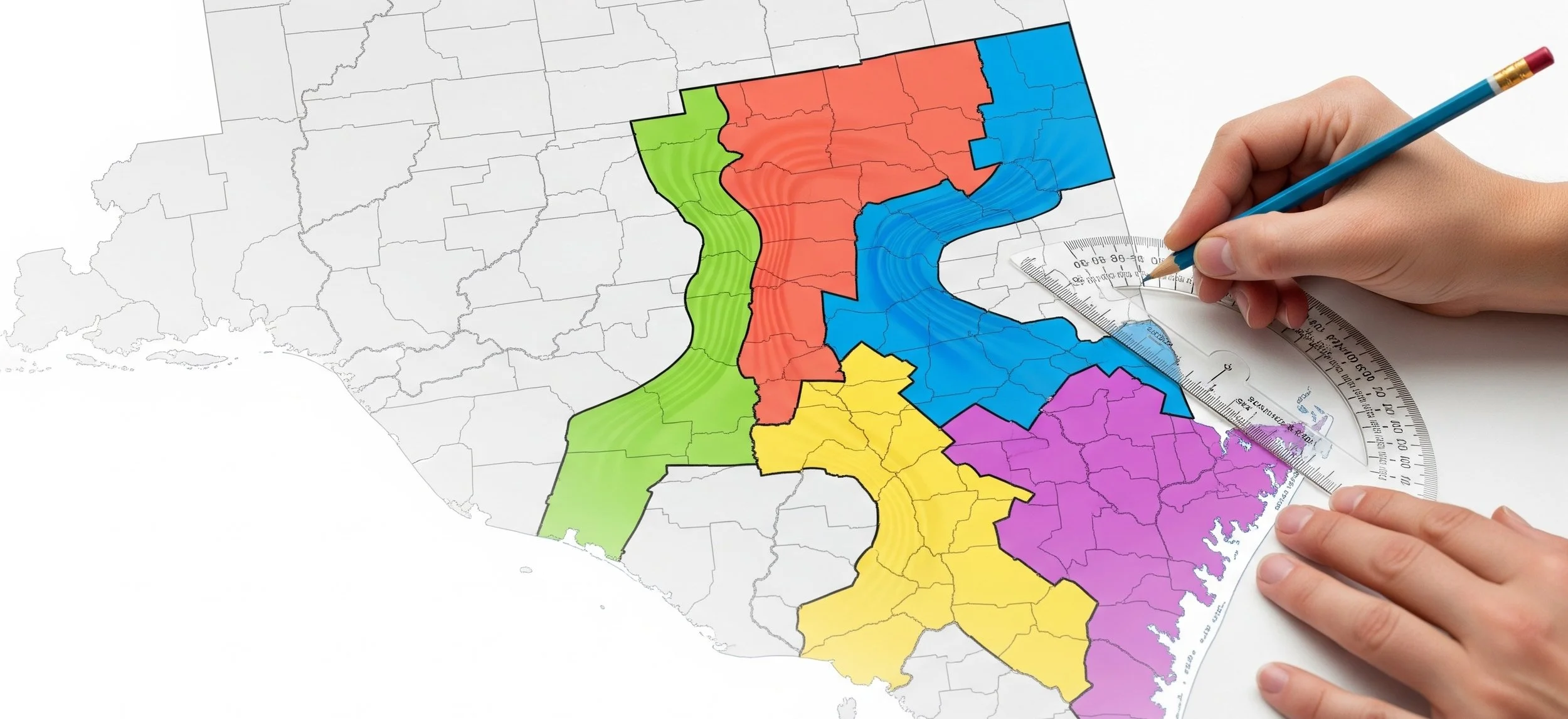
Inside Redistricting
“Redistricting is like an election in reverse. It's a great event. Usually the voters get to
pick the politicians. In redistricting, the politicians get to pick the voters.”
— Tom Hofeller
What is Redistricting?
Redistricting, also known as reapportionment, is the process of redrawing the boundaries of Congressional Districts in order to ensure that each such area within a State is roughly equal in population. In this way, citizens can be assured that everybody shares the same level of representation.
As an example, imagine a State with a population of 3 million people, and a total of four Members of Congress in the House of Representatives. Each of these Representatives should speak for approximately 750,000 people. It would be unfair if three Representatives each spoke for 950,000 people, and the other Representative spoke for just 150,000.

Did You Know…?
Where does the word gerrymander come from?
A) From a Latin term meaning warped
B) Defined in the Constitution
C) Combined part of a politician’s name and an animal’s name
D) A newspaper article in the 1700s
You can find the correct answer at the bottom of this page.
This process usually takes place once every ten years, after the decennial census, which is conducted in years ending in zero (1990, 2000, 2010, etc.). The principle of proportional representation and the need to continually ensure its practice is detailed in Article 1, Section 2, Clause 3 of the Constitution. All U.S. House of Representatives, State legislative, and Local government Districts must be redrawn through the reapportionment process.
Redistricting can also be done more often, usually when a court orders boundaries redrawn (if Districts have been constructed in such a way as to disenfranchise a minority group). If the political majority in a statehouse changes, then the incoming party might also seek to redistrict more often than once a decade. In 2025, several States have performed mid-decade redistricting to allow the party in power to seek political advantage.
Redistricting of State legislative Districts is most commonly done by the majority party of that State’s lawmakers. Some States use independent commissions to do so, which are almost always created through the initiative process, when citizens vote in favor of establishing such a commission. Lawmakers rarely volunteer to give up their ability to redraw Districts, since they can manipulate those boundaries to favor members of their own political party; such machinations are called gerrymandering. U.S House Districts are usually redrawn by whoever draws their State legislative Districts. Local governments can choose how District lines are redrawn in their area.
Courts usually only get involved when lawmakers or commissions fail to pass a redistricting plan, or when they are sued for racially discriminatory practices. If courts do intervene, they often appoint a panel of special masters to draw up new District maps. In a 2019 decision, the U.S. Supreme Court ruled that partisan redistricting challenges were beyond the reach of Federal courts.
When it comes to utilizing redistricting for partisan purposes, gerrymandering is not the particular province of one party or another. Indeed, this unethical process is truly bipartisan
The Nuts and Bolts of Redistricting
Since I have actually worked on creating legislative redistricting plans, I can take you behind the scenes of this usually secretive practice.
The process of redrawing District lines is actually pretty pedestrian. First, you project the new average District size by dividing the State’s population by the number of Districts. Once the average District size is determined, each District is analyzed to see how over- or underpopulated it is. Redistricting is based on population counts, not the number of registered voters.
In redistricting done by lawmakers, the leaders must decide which one of three basic types of plans they want drawn:
A plan that protects the Districts of the majority party and undermines seats held by the minority party, from a small, targeted number to a more aggressive gerrymander.
A plan to protect incumbents of both major parties. Some believe this is worse than partisan gerrymandering, since it reduces competition even more.
A competitive redistricting plan.
You can guess which option is least likely to be chosen when redistricting is done by lawmakers. Yes, Option 3, a competitive plan. According to this study, States that utilize independent redistricting commissions usually produce plans with more competitive Districts than those conceived by lawmakers.
Support or opposition to redistricting commissions often depends on which party has the power to draw lines in a given State. Although they usually have no power to alter boundaries, the Governor of a State often plays a key role in redistricting plans drawn up by State legislators, since the Governor usually has the power to sign the bill into law or to veto it.
The wording of redistricting bills contains mostly descriptive language, such as:
“District 1 shall consist of the following whole counties: A, B, and C, plus those parts of County D north of Highway 123 and east of State Route 456…”.

Let’s Prepare to Draw Some Lines
Let's go over how the redistricting process actually works. We're going into the back room, so watch yourself!
To begin, you need to gather the necessary data and choose mapping software to manipulate District borders and move them around to create the new boundaries. Sophisticated software applications for this process have existed for quite some time.
The information necessary for redistricting usually comes from two sources. The census provides population counts, and voter-registration rolls provide political data from counties. The latter always includes voter registration numbers, and some also use election results.
Census population data is available on national, State, county, city, census-tract, block-group, and block levels (like the one on which you live). The working database primarily comprises county, city, and census-tract levels.
As you create or modify District lines using a digital pen or other computer-based input device, you can see how potential new boundaries impact the demographic and political makeup of Districts.
Extremely aggressive, gerrymandered District lines can look like they were drawn by the winners of a psychedelic-mushroom–eating contest. But not all oddly shaped Districts have been gerrymandered. There can be other reasons for misshapen boundary lines, such as simply following a city’s borders that reflect the haphazard incorporation of new areas over time.
Changes to the Voting Rights Act Will Make Gerrymandering Worse
With recent decisions by the U.S. Supreme Court, gerrymandering is likely to become more common, and the redrawing of District borders more aggressive.
Among other protections for voters, the 1965 Voting Rights Act (VRA) required States and specific regions with a history of discriminatory voting practices to submit their redistricting plans, as well as major proposed changes to election laws, to the U.S. Department of Justice for preclearance. In this way, the Federal government could prevent at least some abuses from impacting minority voters. But in its 2013 Shelby v. Holder decision, the Supreme Court gutted significant portions of the VRA, including the preclearance provision that protected against at least some extreme gerrymanders.
Here's a real-world example of the benefits of preclearance. At the time I worked on redistricting, a few California counties were covered by that provision, owing to their history of discriminatory voting practices. If any State Senators demanded outrageous modifications to District boundaries, our staff could honestly make the case to them that doing so would make it less likely for the plan to stand up to legal scrutiny. That made it more difficult for lawmakers to make such demands.
With the Supreme Court’s elimination of the preclearance requirement, and the curtailing of other such protections, key guardrails for redistricting have been removed. Rather than reinforcing the Voting Rights Act, the Court shifted the responsibility of protecting voters to Congress. Further, in its 2019 Rucho v. Common Cause ruling, the Court held that, “Partisan gerrymandering claims present political questions beyond the reach of the Federal courts.” As a result of all this, State Legislatures controlled by one political party essentially have been given free rein to redraw districts at will.
Fortunately, State Courts have generally shown greater concern regarding extreme gerrymandering. Some have ordered such redistricting maps to be redrawn.
Electoral competition could have been further reduced if the U.S. Supreme Court had bought into a theory called the Independent State Legislature Doctrine. A ruling favoring this doctrine could have eliminated the power of State Courts to enforce their own State's election laws, relegating such decisions wholly to partisan State Legislators. What could go possibly go wrong there?
Fortunately for our democracy, in its 2023 Moore v. Harper decision, the Supreme Court rejected this particular reading of the Constitution. At the same time, they did not rule unanimously, with three Justices supporting it. The Court also left themselves some wiggle room to revisit the issue at a later date.

Other Redistricting Strategies and Notes
Let’s say you’re not interested in gerrymandering, but you want to create new District lines that for the most part follow existing boundaries, adjusting only for differences in population growth since the last census. To do that, it’s mostly a matter of adding or subtracting population to reach the average size for each District.
As a courtesy to each other, Members of each legislative chamber usually approve the other chamber's proposed District lines, as is. The Governor can then sign or veto the bill, which is why having a Governor of the same party that drew the lines is so important to that party.
On a lighter historical note, not even knowledgeable political observers pronounce gerrymander correctly. Elbridge Gerry, the 18th-century politician after whom the term was in part named, pronounced his surname with a hard G—more like Gary than Jerry. So the word should reasonably be pronounced not as gerrymander, but as Garymander.
Summing It Up
I hope this look at redistricting has been useful in adding to your knowledge of this important and consequential task. Virtually every aspect of gerrymandering is bad for our democracy, especially in its ability to prevent competitive elections, instead making it virtually impossible to unseat an incumbent. The bottom line is that the public should keep lawmakers as far away as possible from the redistricting process. Doing so is essential to increasing electoral competitiveness and public confidence in our elections, and to having a more functional democracy.
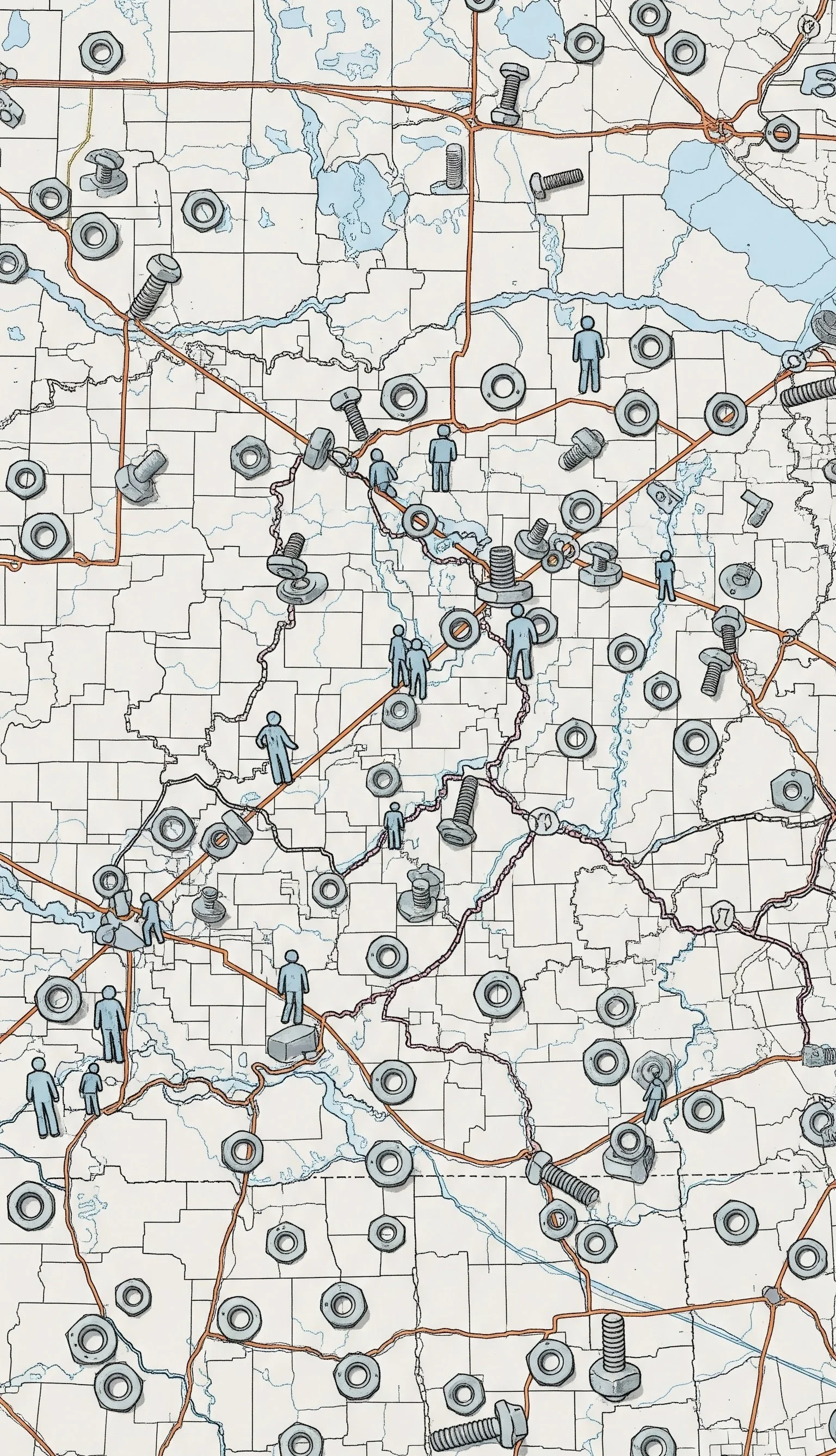
Though the process can get pretty intense, here's a bit of redistricting humor that's actually a true story. One of our Committee chairs had a reputation for being hard on staff, a not uncommon characteristic for lawmakers. (This guy was actually both a first-rate lawmaker and a good person.)
I decided to have a little fun when I showed him our proposed map for his redrawn District, which had two large, distinct portions, connected together by way of a much narrower area. When he inquired where the two sizable sections linked, which they're required to do, I asked if he knew of a certain cafe in a particular town. He said that he did. I then asked if he knew that the cafe had a salad bar. He offered a more quizzical nod and said that he knew that too. So I told him:
"Well, somewhere north of the onions, but southwest of the olives, that's where they connect.”
More bemused than amused, at least he didn't fire me.
Answer to the Did You Know…? Question
The answer is C) Combined part of a politician’s name and an animal’s name.
Elbridge Gerry was a respected politician in the late 1700s and early 1800s. He signed the Declaration of Independence, served as governor of Massachusetts from 1810 to 1812, and was elected Vice President under James Madison in 1812. While governor, he tried to change the shape of voting districts to help members of his political party get elected. His system resulted in some very oddly shaped districts, including one (Gerry’s home district) that looked a little like a newt. Upon seeing a map of the bizarre regional divisions, a member of the opposing party drew feet, wings, and a head on Gerry’s district and said, “That will do for a salamander!” Another member called out, “Gerrymander!” Thus gerrymander became a term for such political schemes.