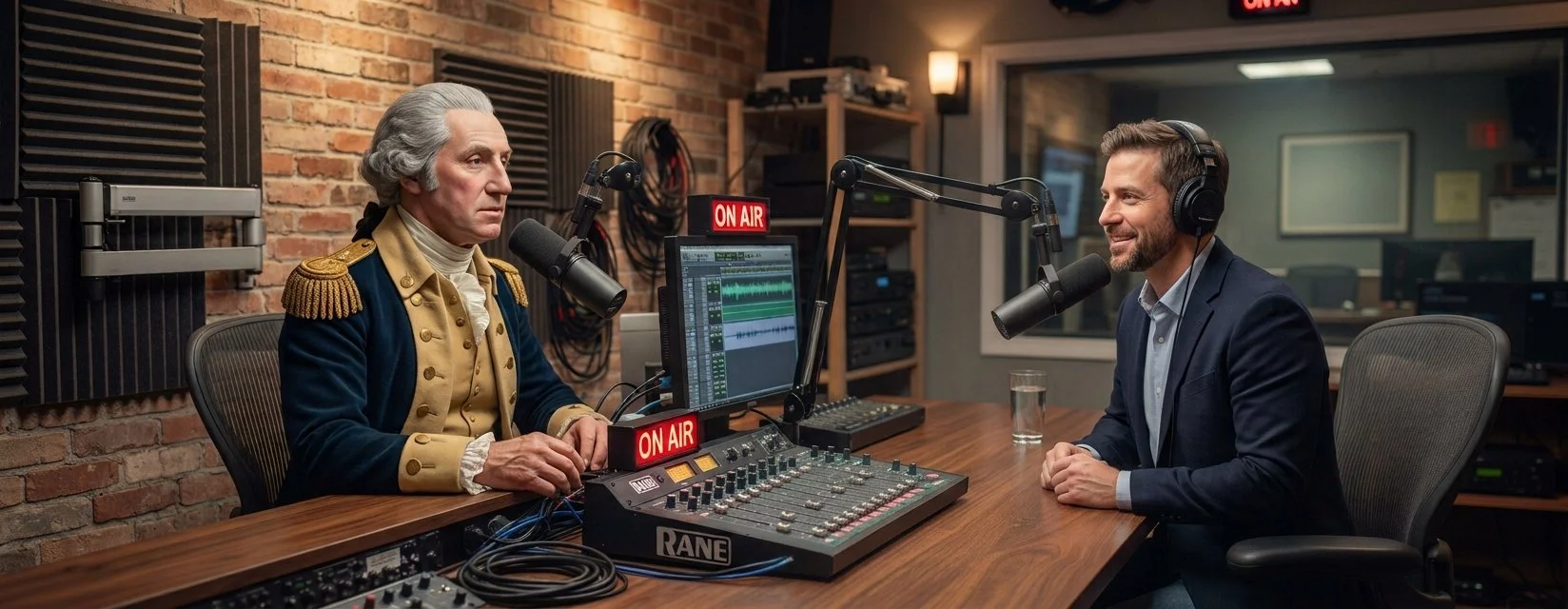
Interview: R. H. Hertz
R. H. Hertz began his career working in State government, seeing firsthand how the sausage gets made (or in many cases, doesn't get made). His subsequent work as an independent pollster spanned decades, as has his time in colleges teaching political science.
This interview was conducted by writer David R. George III, and completed on October 11, 2026.
Introduction
David R. George III: Welcome, Mr. Hertz…to your own website. I know it must feel strange to be interviewed for inclusion on GeorgeWasRight, considering that GWR is your brainchild and labor of love. Also, as a pollster, you are normally the one asking the questions. But it seems reasonable for visitors here to understand how the site came to be. Thanks so much for taking the time to do that.
R. H. Hertz: Thank you, Mr. George. It’s a pleasure to answer your questions. Was just wondering, are you related in any way to the site’s namesake?
Just kidding, of course. Shall we begin?
Nonpartisan Approach
DRG III: GeorgeWasRight has a lot of information about the U.S. system of government, how it’s supposed to work and how it actually does, how money has infiltrated all of it and corrupted politicians, and what the ordinary citizen can do to help make government function better. And yet the site doesn’t talk directly about either of the two major political parties—or for that matter, about any political parties or current politicians. Why did you make that choice?
RHH: I chose not to focus on the two major parties or active, individual politicians for several reasons. George Washington, for whom this site was named, was not a fan of political parties. In his farewell address and other writings, he warned of their inherent divisiveness, especially to a fledging democracy. He was right then, and is perhaps even more so today, since they often seem to exist merely to oppose each other to gain majority power. I also chose not to focus on individual politicians since there are countless other venues to do that. I want GeorgeWasRight to go beyond the same, tired political blame game to instead emphasize voter-driven potential solutions to our political woes.
Interest in Government and Politics
DRG III: How did your interest in government and politics arise?
RHH: At the old dining room table, of course. Our parents instilled in both my older siblings and me the importance of following the news about politics and government. Dad often began our dinner table conservations by asking, “What did you do today to make the world a better place to live?” Like many kids, I didn’t have much to say about that. He reinforced the need to follow the news, suggesting we read the editorial page to get a better view of the political debate. No wonder I became a public opinion pollster and teacher!
Working in State Government
DRG III: What did you learn from your time working in State government?
RHH: Since my first substantive job after completing my formal education was working as aconsultant on an elections and reapportionment committee, I saw some of the worst aspects of politics up close. My only other stint in or around government was examining the money in politics for an agency that regulated it. Later, I helped a major newspaper make campaign finance and lobbying data more transparent to the public. As dismaying as working in those areas of politics could be, I learned a lot about redistricting and the flow of money in politics, knowledge useful for teaching college students and informing readers here at GWR.
Lessons Learned as a Pollster
DRG III: How did working as a pollster inform your opinions about government, and about what people could do to improve it?
RHH: Being a longtime public-opinion pollster has taught me why so many have such little faith in our representatives and government. Many folks pay little attention to political goings-on because they feel nothing ever changes, regardless of who gets elected. I see much the same thing as a teacher, based in part on how little education most students get about politics and government—usually, at best, just one or two courses. The teaching of civics and how to get more involved in public decision-making is really underemphasized these days. That’s one reason why I created GWR, in part as something of a free online civics course for the public, so people can learn how they can get more involved in public decision-making'.
Motivation
DRG III: What motivated you to assemble all of this information in one place?
RHH: I wanted to create a place where people with widely varying levels of knowledge about politics and government could learn things they didn’t know, from someone who’s practiced in these fields. Having conducted polls and election projects for many local news organizations (when they had the money to do them), I got to know and work with many fine editors and reporters. Though many people feel most news reporting is biased, my experience has been different. In working with news entities with widely varying editorial points of view, I was never once asked, nor was it even suggested or hinted at, to shade a poll’s results in any way. I hope my Inside the Newsroom piece is helpful in better understanding how professional journalists really work.
Intended Audience
DRG III: Who is the target audience of GeorgeWasRight?
RHH: Though I feel the content on GeorgeWasRight should be useful to many, regardless of their level of political knowledge, I wanted to make an extra effort to reach folks who didn’t get much of an education about politics and government, specifically so they can get more involved with decisions that impact them. For our democracy to thrive, the widespread feeling of helplessness to change things has got to go. No easy task, for sure, but recent changes in how candidates can now run for office—free from the burdens of party and special-interest money—is a potential game changer. On GWR, visitors can learn about these changes, as well as other things they can do to help make them happen.
DRG III: I know that you talk on GeorgeWasRight in several places—such as in your cleverly titled Is It Time for a Declaration of Independents?—about the ability for candidates to now run essentially free from parties and special interests,
Social Media &
Commenting
DRG III: Why does GWR have no direct Social Media presence?
RHH: Because, at least for now, I really want to focus on creating stimulating content on GWR. There are lots of other ways besides social networks to publicize GeorgeWasRight. If you want to help spread the word, feel free to share our content by using the SHARE BY EMAIL and SHARE BY TEXT buttons at the bottom of every page, or just by telling anyone you think might be interested in our content in whatever way you like. I’m also not averse to people sharing links to GWR’s content on their own Social Media.
We have also chosen not to allow public commenting on the site, simply to avoid disagreements between visitors. At the same time, we are always eager to get feedback about GWR, which people can provide either by taking our VISITOR EXPERIENCE SURVEY, or by using the CONTACT page to reach out to us directly.
We’re also exploring innovative ways to reach a wider audience, with even more useful information and features. Stay tuned for coming attractions! You can always learn about new content by checking out the WHAT’S NEW? link at the top of every page.
No Cost to Visitors
DRG III: Even a quick peek at GeorgeWasRight reveals that it is completely free—even to the point where there are no ads, no on-site purchases available, no subscriptions. What are you getting out of this?
RHH: Simply because we’re constantly bombarded with all of the online irritants you mentioned, I want GWR to be a pleasant respite from the usual SIGN UP, SUBSCRIBE, or BUY options that we often encounter on the Internet. It’s free because I didn’t want any barriers for people who want to view the content without having to cough something up.
If visitors like what they find here and want to support the ongoing work, they can contribute to the cause by donating to its upkeep. GWR is free for people to read and enjoy, but that doesn’t mean there are no costs to develop, maintain, and update it. I’m hopeful that at least some people will use the DONATE page to help GeorgeWasRight remain a growing and ongoing concern. Thanks!
Reasons to Be Here
DRG III: Why should people visit GWR?
RHH: If they want to be better informed and learn what they can do to help bring about much needed change, they’ll quickly see how to do these things on GeorgeWasRight . They’ll find the tone conversational, not confrontational. If they want to see what they do and don’t know about the topics we’ll cover, they can give our Knowledge Assessments a whirl. Given how much of a downer politics and government can be, we’ve even slipped in some humor here and there too. But on top of it all, visitors will learn ways that they can help bring about the meaningful change that’s needed! It’s actually not as difficult as it may seem, if enough of us take the rather modest time and effort necessary to make it happen.
Goals
DRG III: What are your greatest hopes for the site?
RHH: That GeorgeWasRight becomes a widely used and trusted resource to help people become better informed about how politics and government work, to make more informed decisions (beyond political party) about who and what they vote for, and to get more involved with public decision-making in whatever ways they can. Thank you!
DRG III: Thank you so much for taking the time to share your thoughts with—and about—GeorgeWasRight!