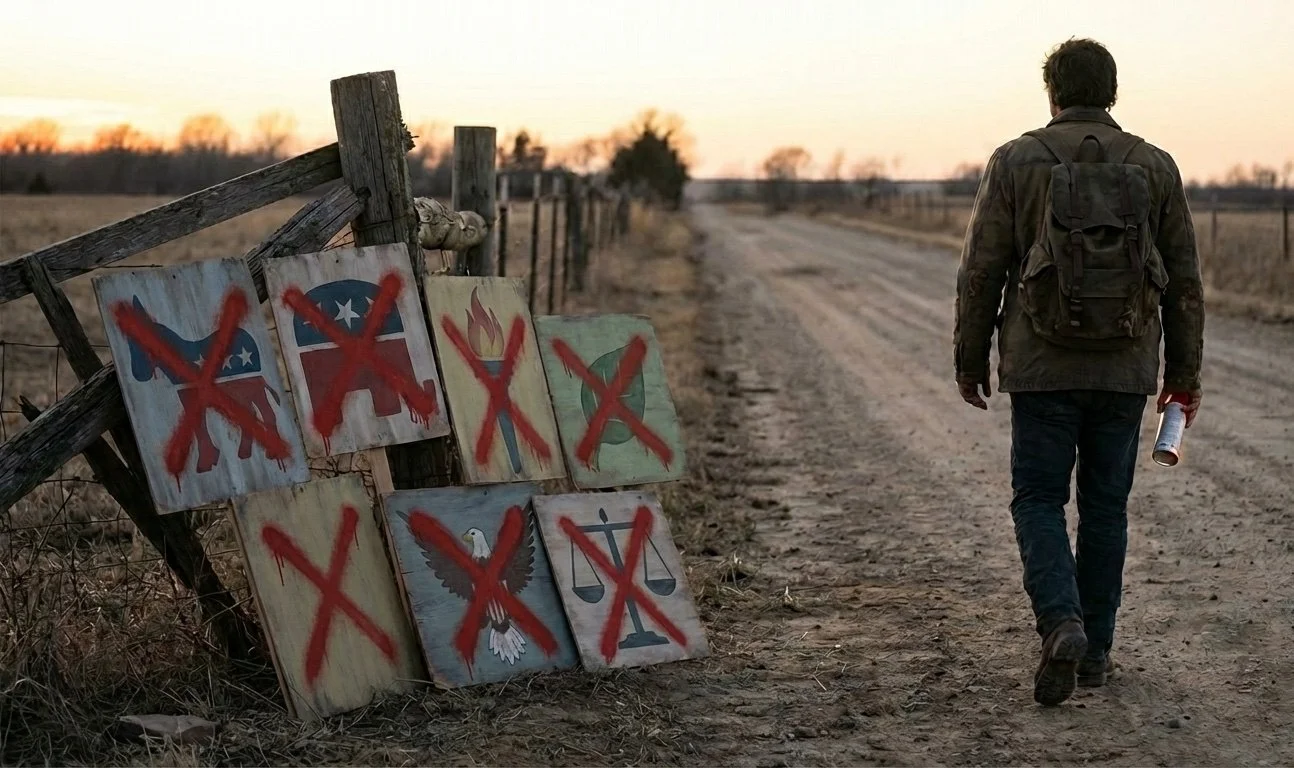
Is It Time for a
Declaration of Independents?
“I always defer to verifiable evidence and therefore I cannot be a member of a political party.”
— C. A. A. Savastano
Parties Made More Sense…Long Ago
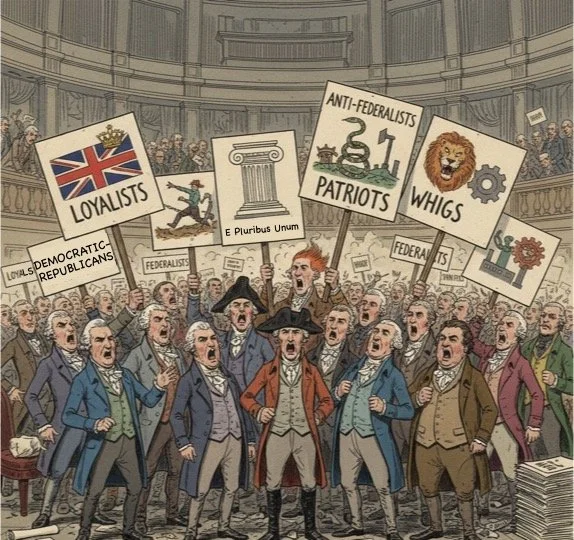
During the early years of the United States, political parties served important purposes. For one thing, they provided an alternative for citizens to hear something other than the government’s point of view. Additionally, in a time without cell phones and landlines, without television and radio, without even the telegraph, political parties helped to disseminate information to voters about the candidates on the ballot. Today, parties are still useful in assisting like-minded voters and representatives to organize. At the same time, their divisive nature has always been a heavy counterweight to their potential benefits.
Today’s unrestrained hyper-partisanship has made political compromise all but impossible to achieve. This holds true even in dealing with life-threatening tragedies—such as the pandemic and mass shootings—that have become distressingly regular events. It’s one thing for lawmakers to argue over tax breaks and the like, but quite another when they can’t set aside partisanship to address matters with broader implications, like public safety and foreign policy.
From an international standpoint, seeing our divide along party lines can allow the nation’s adversaries a tremendous advantage in how they deal with the U.S. Some may act more aggressively if they perceive the country as politically fractured. Additionally, it is important for our allies to have confidence that America will be a reliable partner.
In Another Time…And Impeachment
It’s tempting to think that the country has always been this politically divided. After all, the U.S. suffered through a bloody civil war in which approximately 2% of the entire population perished. When it comes to competing parties and interests, our politics are rarely thought of as conciliatory. Nevertheless, today’s partisan divisions seem to be more rigid, more intense, and never-ending.
One way to demonstrate the dramatic increase in partisan tensions is through comparison of the impeachment hearings held in Congress during the 1970s, and those held more recently. During the Watergate scandal, which involved the sitting President, the subsequent investigation and calls for action initially divided along party lines. But by 1974, about a third of the Members of the House belonging to the President’s own party voted in committee for impeachment. In 2021, in the aftermath of the January 6th attack on the U.S. Capitol, which had also involved the sitting President, only about 5% of the Members of the House belonging to his party favored impeachment.
Congressman William Hungate of Missouri, who voted in 1974 voted to impeach the President, a member of his own party, summed up how unfettered partisanship can distort the ability for people to agree on even obvious facts. He said:
“If a guy brought an elephant through that door and one of us said, ‘That’s an elephant,’ some of the doubters would say, ‘You know, that’s an inference. It could be a mouse with a glandular condition.’”
You can see Congressman Hungate’s comments and the agony member of both parties experienced regarding that earlier impeachment in the excellent two-part PBS documentary, Summer of Judgment: The Watergate Hearings and Summer of Judgment: The Impeachment Hearings. (Hungate’s comments occur at 36:08, though the entire video is worth watching.) Eventually, when the contents of an incriminating audio tape became public, a large bipartisan majority of both Congress and the public supported the President’s removal from office. (He would ultimately resign his office before that could happen.) The seriousness with which that earlier committee undertook its responsibilities contrasts sharply with the votes largely along party lines in the two recent impeachment proceedings.
Congress Does Not Look Like America
The demographic makeup of Congress looks considerably different from the people they represent. Overall, the U.S. Senate and the House of Representatives are predominantly male, and older, whiter, and far wealthier than the general public. Note that many lawmakers grew considerably richer after being elected to the Federal government, something we’ll explore in a future topic.
Another way in which Congress looks little like the people they represent comes in terms of political affiliation—or the lack thereof. Frustration with the two major parties has led to both a decrease in the number of voters who identify with them, and an increase in the number who are independent (meaning not a member of any political party). According to this Gallup poll, a record high percentage of Americans now consider themselves independents. Nearly half (45%) said they preferred not to affiliate with a political party, while membership in the two major parties has dropped to 27% each. Despite all of this, independent lawmakers, as of 2026, hold barely a third of a percent (0.37%) of the seats in Congress.
In 2004, the electorate split roughly between independents and each of the two parties. That’s been replaced with essentially a two-way split, with about half of voters now considering themselves independent. This is a significant jump in less than two decades, which may have implications for future politics, elections, and governance.
The movement away from political parties and toward independents is especially strong among younger generations. Their growing political footprint will increasingly dominate our politics and elections. Democracy does not function well when lawmakers aren’t representative of their constituents and don’t understand the problems many of them face.
This is Something We Can Change
I understand that closing these gaps poses a significant challenge. But if we look past some mostly irrelevant history, and if we change some of our voting habits that enable the partisan duopoly, it can be done.
For a long time, casting a ballot for an independent or third-party candidate was perceived as a wasted vote. To some degree, that made sense, since such candidates rarely won. Independent candidates were also sometimes blamed for siphoning off enough votes from another candidate to alter the election outcome. But all of that was prior to the mass migration of voters from political parties to independent, which has intensified in recent years.
With large and growing numbers of people disgusted with the two major parties, having half the population politically independent but vastly underrepresented in Congress and other legislative bodies is neither desirable nor sustainable. And since independent candidates can now finance their campaigns with many small donations, they no longer have to depend on financial support from either parties or special interests. That in turn means that elected independent lawmakers will have no implied obligation to anybody but the people they represent.
Additionally, in recent years, candidates’ reliance on expensive television advertising has begun to diminish. Many voters tune them out completely, diluting their impact. Such ads typically prove most effective with respect to ballot measures and races for lesser government offices.
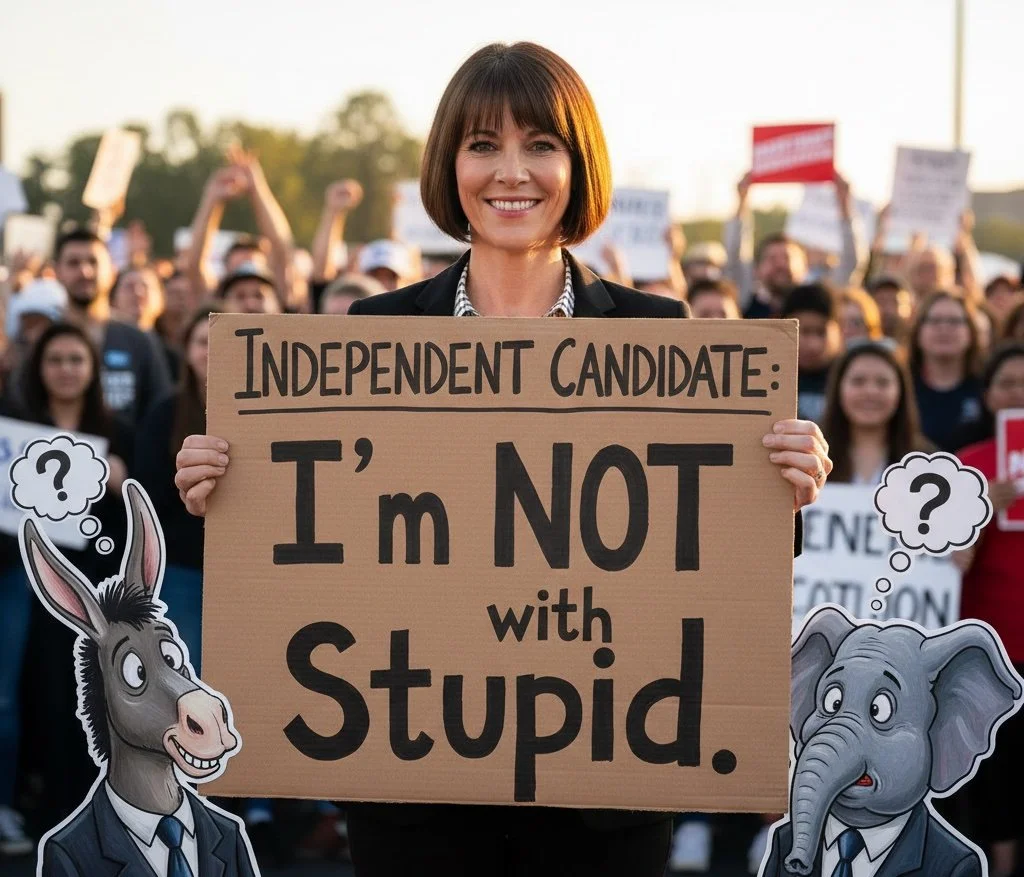
Besides their high costs, 30-second TV ads don’t really lend themselves to telling compelling stories that move a lot of voters. Newer was of campaigning have evolved, including candidates posting longer-form videos on YouTube, TikTok, and other online platforms. These allow for deeper messaging, big audiences—lots of people have lots of followers—lower costs, and a more personal connection.
It is worth noting that the online tools younger people are expert at using are now being employed for voter registration, political organizing, and turn-out-the-vote efforts. When adding it all up, there’s a pretty good case to be made for the potential ascension in the near future of independent candidates. The political marketplace will tell us whether or not this turns out to be real or just a mirage.
If even just a handful of new candidates are elected as independents, the wasted-vote theory may soon wither. The widespread dissatisfaction with parties, and the dysfunction of our political system, have combined to create a volatile political atmosphere. That could lead to change on levels difficult to see or even to imagine.
Summing It Up
Today, we have an upside-down political system, where voters by and large want greater bipartisanship, while our representatives are mostly moving in the opposite direction. Such a considerable disconnect raises questions: do parties do more harm than good, and does strict adherence to party dogma promote laziness among candidates and voters alike?
On a more fundamental level, we need to ask ourselves if we’ve simply outgrown the two-party system. Does anyone but the most hardcore partisans believe the views of over 340 million Americans can be condensed neatly into just two boxes?
The case for parties might be stronger if they consistently adhered to a set of principles, but they don’t. For example, the concerns of many lawmakers about budget deficits change depending on whether or not their party is in the majority, with the power to make spending decisions.
If we want less partisanship, it is within our power as voters to force the issue. Since many young people don't choose a party when they register, perhaps it’s time for the younger generations to lead—both as smart, well-informed independent voters, and also as independent.
Our 1776 Declaration of Independence worked out pretty well. A modern-day Declaration of Independents might do so too.
Did You Know…?
Approximately 50% of the U.S. population is female. In the entire history of the country, what percentage of Senators and Members of the House have been women?
A) 3%
B) 10%
C) 27%
D) 49%
You can find the correct answer at the bottom of this page.
Answer to the Did You Know…? Question
The answer is A) 3%.
As of February 2026, 2,018 people have served as U.S. Senators, only 64 of which have been women. Meanwhile, 11,262 people have served as Members of the House of Representatives, with only 405 of them being women. That means that only about 3.5% of our Federal lawmakers have been women, despite that they comprise about half the population.