Federal Court System
“The mechanism of the heavens was clearer, the mechanism of their courts was still murky.”
— Bertolt Brecht [Translated by Charles Laughton]
Federal Judiciary
As discussed in Three Branches of Government, the fundamental responsibility of the Judicial Branch is to interpret Federal Laws. Its duties include applying Federal law to real-world situations, as well as determining whether a particular law violates the Constitution. The Federal Courts make up the Judicial Branch, which includes District Courts, Circuit Courts of Appeals, and the Supreme Court.
The Federal Judiciary may be the least well-known branch of the government, not least of all because significant parts of its workings are shielded from direct public view. Federal Court trials and hearings are usually not televised, due largely to concerns about attorneys playing to the cameras, and by extension, to the public. Audio recordings of public hearings are available, though, on the particular Court’s website.
In this topic, we will discuss U.S. District Courts and U.S Circuit Courts of Appeals. You can read in a separate topic about the U.S. Supreme Court. It is important to understand the Federal Court system, since the decisions it makes are often the final words on the laws by which we live.
Basics of the Federal Courts
The vast majority of cases in our Judicial System are decided in State Courts, rather than in Federal Courts. State Courts deal with nearly everything from minor traffic violations to violent crimes, while Federal Courts handle Constitutional questions; disputes between branches of government, between the Federal government and State governments, and between different States; bankruptcy; immigration; and a few other specific areas of the law. The Judiciary itself provides a comparison between Federal and State Courts.
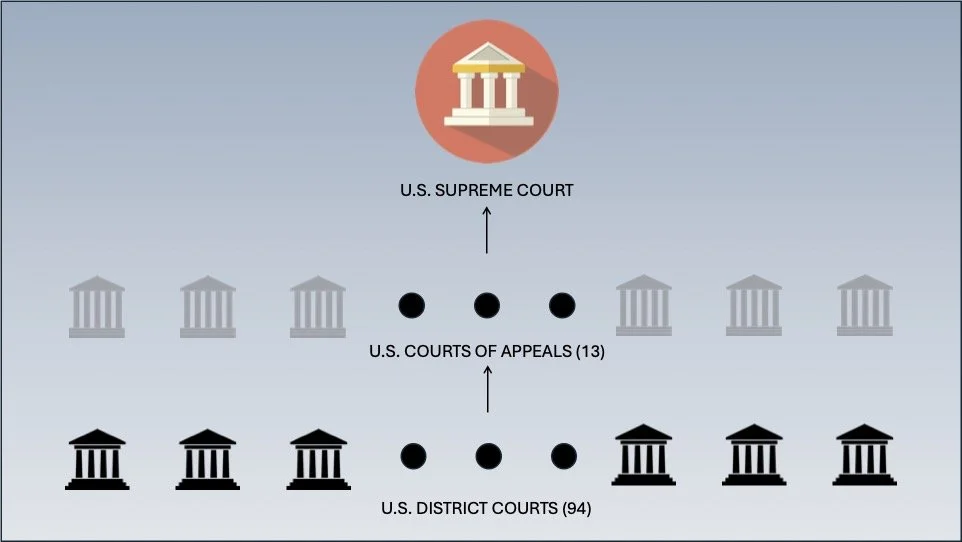
As mentioned, the Federal Judiciary comprises three primary levels: District Courts, Circuit Courts of Appeals, and the Supreme Court. Only District Courts hold trials. There are a total of 94 such courts, with at least one in every State. Both the Circuit Courts of Appeals and the Supreme Court handle mostly appeals—that is, requests to validate or overturn decisions from lower courts.
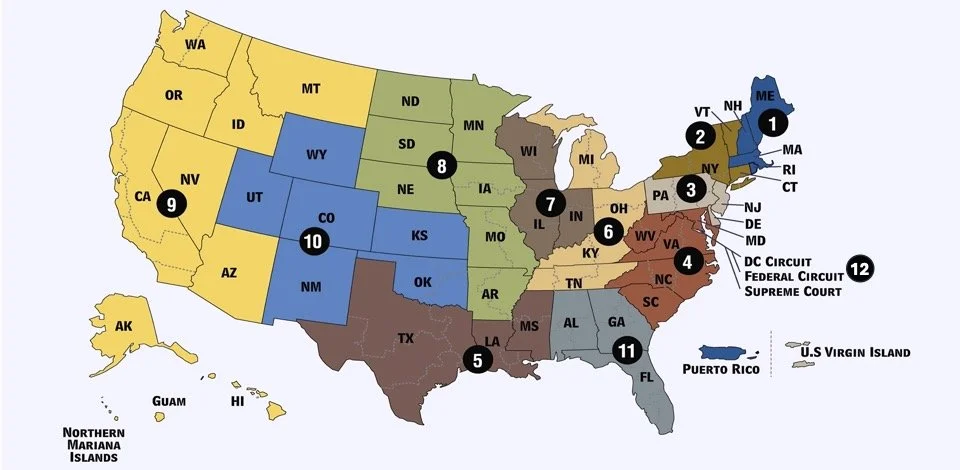
There are 13 Circuit Courts of Appeals, organized regionally across the United States. Each State or area is assigned to one of 12 Circuit Courts. The thirteenth Court of Appeals, known as the Federal Judicial Circuit, has nationwide jurisdiction to hear a few specialized types of cases. Most Circuit Courts of Appeals have between 11 and 17 Judges, though the First Circuit has only six, and the Ninth Circuit has 29. The exact number of judges serving at any given time on a particular Federal Court can change due to vacancies and other factors.
The Supreme Court has nine Justices, and they are the only Federal Judges to hold this title. The Supreme Court is the final arbiter of U.S. laws and legal disputes.
All Federal Court Judges and Justices are appointed by the President, but they must also be confirmed by a simple majority of the U.S. Senate. They serve lifetime terms, although they can be removed for cause via the same impeachment process used for removing a President. Unlike their Federal colleagues, State Court Judges and Justices hold elective office, meaning that they must at some point face voters. Later, we’ll examine those judicial elections, depending on the state and level of the court, as well the positives and negatives of having state Judges and Justices run for their offices.
Getting a Case Heard in Federal Court
The party bringing a case to Federal Court, called the plaintiff, must show standing—the legal capacity to bring a lawsuit. To do this, the plaintiff must demonstrate a sufficient connection to, and harm from, the Federal law or action being challenged. The rules for bringing a case to State Court are similar, but with respect to State or Local Law.
For example, let’s say that either a Federal or State case has been filed against defendant XYZ Bank for cheating consumers with illegal fees. The plaintiff could be an XYZ Bank customer at the time of the alleged illegal activity, which shows both a sufficient connection to, and harm from, this activity.
Federal Court Trials and Appeals
Federal District Court trials are in many ways similar to their State counterparts. A judge is randomly assigned to hear a case, and the defendant can usually ask for a trial where the verdict is reached either by a jury or by the judge. (If you’ve ever thought about demanding a jury trial for a minor traffic violation, forget it. Most such acts are classified as infractions, the least serious category of legal offense. They are distinguished from misdemeanors and felonies primarily by the absence of potential jail time or probation, with penalties usually limited to fines or community service. Unlike more serious offenses, infractions generally do not create a criminal record, and they are ineligible for jury trials.)
After a verdict is reached in a Federal District Court trial, the losing party can appeal the decision to the U.S. Circuit Court of Appeals for that region. The map below shows the States and Territories assigned to twelve of the thirteen Circuit Courts of Appeals. The Thirteenth Circuit has national jurisdiction and handles appeals of specialized types of cases, such as patents and veterans’ claims.
Did You Know…?
Historically, with respect to the Federal Court system, what did it mean to “ride the circuit?”
A) A case making its way from the State Court System all the way to the U.S. Supreme Court
B) An attorney or plaintiff repeatedly filing cases in the U.S. Court of Appeals
C) U.S. Supreme Court Justices traveling across the country to hear cases
D) A judge being appointed to a U.S. District Court, then to a U.S. Court of Appeals, and then to the U.S. Supreme Court
You can find the correct answer at the bottom of this page.

If the Circuit Court grants a review, the case is assigned to a three-judge panel randomly selected by computer. The selection process is random so that attorneys in the case can’t go “judge shopping”; that is, so that lawyers can’t seek out a jurist they feel might be more sympathetic to their cause.
The U.S. Judicial Council recently issued new policies in an attempt to curb judge shopping. The proposed changes have run into opposition in some judicial and political circles, though, and so it is unclear how widely these policies will be implemented, or how effective they’ll be.
Should a faction lose their appeal in the three-judge Circuit Court ruling, they basically have three options to continue their case.
Request a different three-judge panel in the Circuit Court to hear the case.
Request the Circuit Court to hear the case en banc, meaning that it will be heard by the entire Court.
Request a Supreme Court review.
Judicial Recusals
All active Federal judges and Justices participate in most cases unless they have a real or perceived conflict of interest. In that circumstance, they are expected to recuse themselves from a particular case, which means that they will not take part in rendering a verdict. The Code of Conduct for United States Judges details the ethical canons applicable to Federal Judges, but it covers only U.S. District Courts and the U.S. Circuit Courts of Appeals, not the U.S. Supreme Court.
Judicial recusals are made by an individual Judge or Justice, and not by some ruling board or oversight authority. Just the appearance of a potential conflict of interest can be a sufficient reason for a Judge to voluntarily recuse themselves from a case. The American Bar Association, in their Model Code of Judicial Conduct, outlines the criteria for such recusals.
Until recently, the Supreme Court had never published a written code of conduct for its members. After numerous reports of certain Justices failing to report the receipt of expensive gifts and free luxury travel, the Court announced that they would adopt a new Code of Conduct for Justices of the Supreme Court of the United States. Unfortunately, the code itself includes no provisions for enforcement of the new rules.
Lifetime Judicial Terms vs. Elected Judicial Terms
While all Federal Judges and Justices serve lifetime terms, nearly 90% of State Judges and Justices must at some point face voters. Some run against other candidates, while others run in retention elections, where voters are asked only whether or not a Judge or Justice should remain on the Court.
Lifetime judicial appointments can be controversial, since it limits the ability of voters to remove from office an underperforming, or worse, unethical Judge or Justice. There are always provisions for the Legislature to do so via an impeachment process, but such actions are typically difficult to accomplish.
At the same time, requiring Judges and Justices to run for election or reelection means that, in order to mount a campaign, they will need to solicit contributions. But as a practical matter, the more funds that they receive from donors, the more likely it becomes that they should recuse themselves from cases involving contributors or others in the same or similar fields. Such recusals stress an already overburdened judiciary, which has a long backlog of cases, frustrating those seeking justice.
In recent years, such election contests have become increasingly expensive and contentious. Despite that judicial roles are supposed to be nonpartisan, both major parties often seek to persuade voters to choose Judges and Justices whose views align with the political positions of the party. No matter how conscientious most Judges and Justices are, it seems prudent to consider the downsides of putting them in situations where the political impacts of their decisions might be questioned because of their fundraising.
How State Courts Are Structured
Having 50 States allows for 50 different ways that their Court systems can be structured. For the most part, though, State Court systems are similar, downsized versions of their Federal counterpart.
For example, as with the Federal Judiciary, California has three levels of Courts. The Superior Courts are the lowest level of the system, occurring in each of the State’s 58 counties. There are six State Courts of Appeals, covering California by region. Finally, at the uppermost level, is the State Supreme Court.
Initially, most California Superior Court Judges are appointed by the Governor when there is an unfilled vacancy on the court, although they can also run for an open seat. All appointed Judges and Justices must be confirmed by a vote of the State's Commission on Judicial Appointments.
After a certain number of years on the bench (depending on the level of the Court), Judges and Justices must face voters either in a retention election, or in a regular election against other candidates. While the vast majority of Judges and Justices are usually retained by voters, California State Supreme Court Chief Justice Rose Bird, along with Associate Justices Cruz Reynoso and Joseph Grodin, were all denied retention in a 1986 election.
Class Action Suits
When a group of people suffer the same or similar damages or injuries, they can bring their case as a group, rather than as individuals. This type of litigation, called a Class Action, saves a lot of time and money for all involved. Such cases can be filed in either Federal or State courts. Due to their complex nature, settlements or other resolutions to such cases can take many years to complete. This article explains more about how such cases work.
Summing It Up
Reasonable arguments can be made for and against both lifetime judicial appointments and judicial elections. The Framers of the Constitution resolved it in a manner they employed in other areas of government: they set one standard for the Federal Courts, while leaving it to the States to decide some aspects of their Court systems.
Voters are unlikely to have much say on the length of the term for Federal Judges and Justices, as they are defined in Article III of the Constitution. In fact, Federal judicial officials are sometimes referred to as Article III Judges and Justices. In order to make any changes to their terms, the Constitution would have to be amended. Given the high bar for doing so—approval by two-thirds of both Chambers of Congress, as well as ratification by three-quarters of the States), that is unlikely to happen, particularly given the current hyper-partisan political environment,
For these reasons, it is vital that State Courts, in feeding cases to the Federal Judiciary, function at the highest possible level. That means you should avoid voting for Judges and Justices based on party, but take the time to study the views and past performances of these judicial officials before making the choice on who to elect and who to retain.
On GeorgeWasRight, you can also learn more about the highest Court in the nation, the U.S. Supreme Court.
Answer to the Did You Know…? Question
The answer is C) U.S. Supreme Court Justices traveling across the country to hear cases.
Prior to 1891, when Congress created a separate tier of appellate circuit courts, U.S. Supreme Court Justices had to travel to different regions of the nation to hear cases. Since 1891, the Federal Court System has largely remained unchanged.