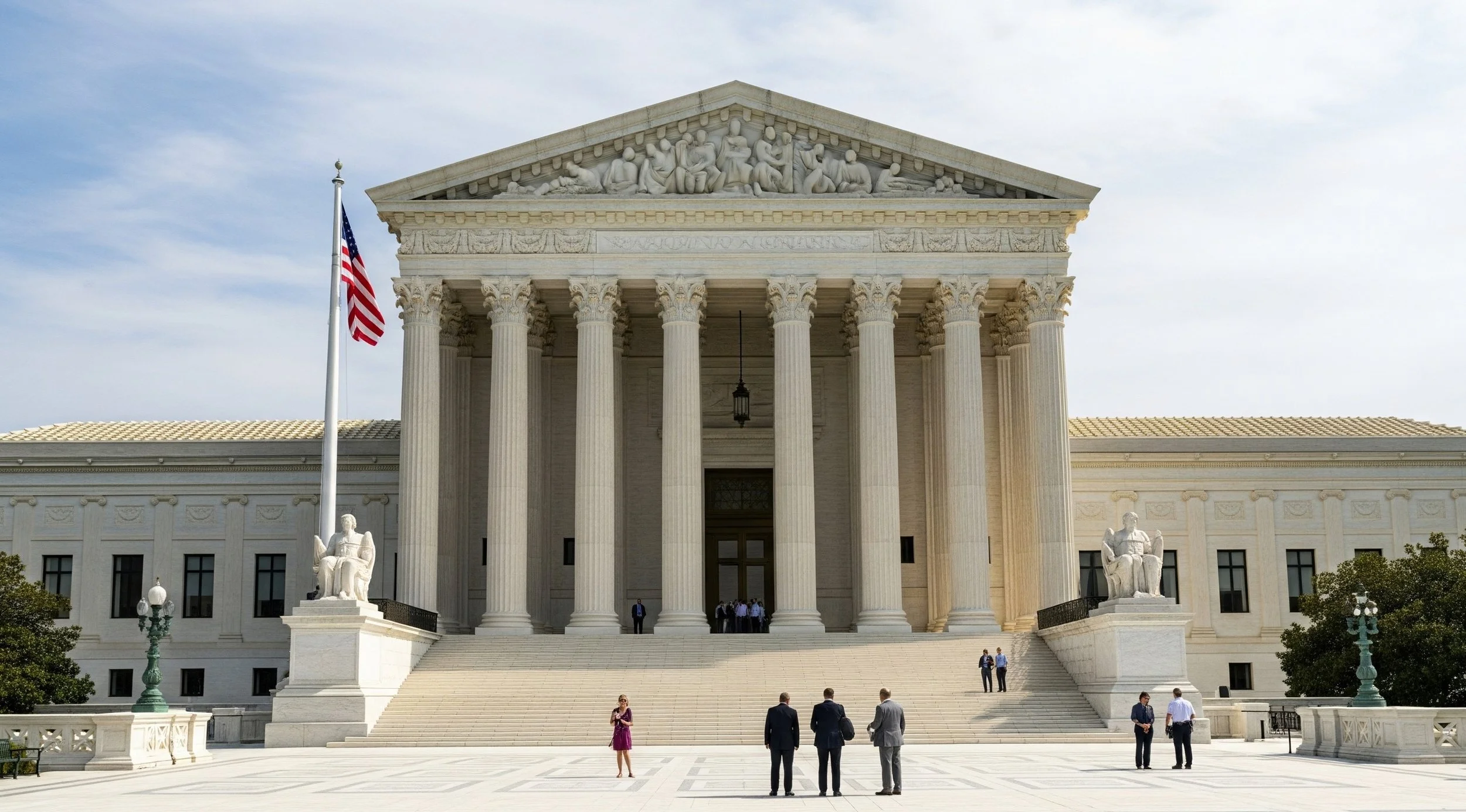
The Supreme Court
of the United States
“There can be no equal justice where the kind of trial a man gets depends on the amount of money he has.”
— Hugo Black (Associate U.S. Supreme Court Justice from 1937-1971)
The Highest Court in the Land
The Supreme Court of the United States—sometimes abbreviated as SCOTUS—occupies the nation’s pinnacle of jurisprudence. It is an appellate court, meaning that it does not host trials, but rules on legal matters that have gone through an often-lengthy appeals process. Such cases originate either in a State Court or in a U.S. District Court. Decisions that have been appealed proceed through a State Supreme Court (in the case of State issues), and then a U.S. Circuit Court of Appeals.
Getting a case heard by the U.S. Supreme Court requires clearing a high bar. It normally takes at least four of the Court’s nine members to grant a review after receiving a petition for a writ of certiorari, a document filed by the losing party in a case, requesting the decision of a lower court be reviewed by SCOTUS. If the petitioner seeks to have the case heard on an expedited basis, they can ask to bypass the U.S. Circuit Court of Appeals and proceed directly to the Supreme Court, in which case five Justices must vote to grant a review. Expedited reviews are typically granted only in emergency situations, or with respect to issues of great public importance.
Each term of the Supreme Court begins on the first Monday in October and usually ends the following calendar year, in late June or early July. During each SCOTUS term, the Court usually receives between 7,000 and 8,000 petitions. The Court typically grants only about 80 of these requests. To avoid wasting the time of the Court, lawyers arguing before the Justices must have been admitted to the Bar of the Supreme Court.
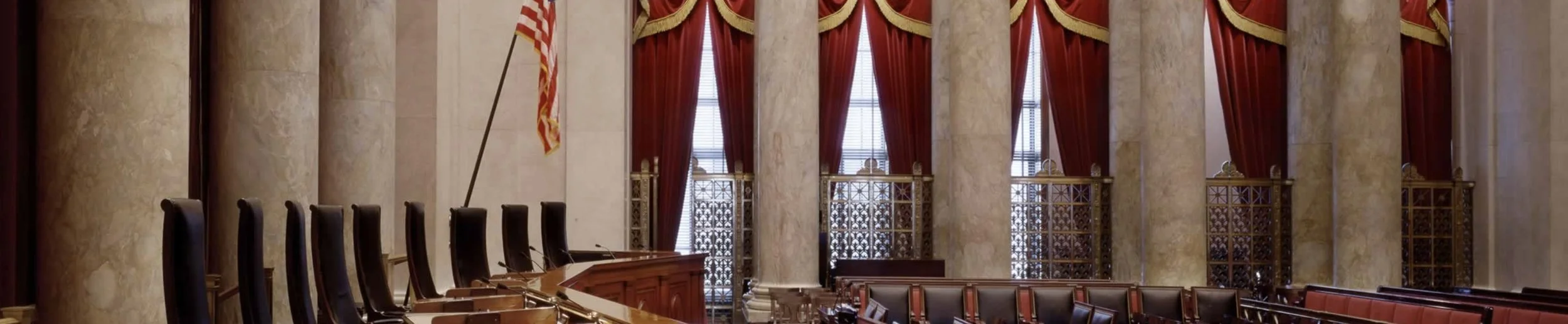
Justices are nominated to the Court by the President when a vacancy arises, either through the death or resignation of a sitting Justice. The nominee must go through confirmation hearings, and then approved by a majority of the Senate. The Justices serve lifetime appointments, although they can be removed from their office via the same impeachment process used to remove a President. This involves the House of Representatives approving Articles of Impeachment by a simple majority. The Senate must then take action, either by holding a trial on the matter or dismissing the charges. A two-thirds majority vote of the Senate is required to convict and remove the Justice from office. No Justice has ever been removed in this manner from the Supreme Court.
Of the nine Justices, one is designated by the President as Chief Justice when that post is empty. The Chief Justice serves as the presiding officer of the Court, managing the selection of cases, overseeing public sessions and private conferences, and assigning the drafting of opinions. The Chief Justice also functions as the administrative leader of the entire Federal Judiciary.
Each Justice hires several law clerks to research cases and help with the drafting of opinions. The term clerk can be deceptive, as most are graduates of prestigious law schools. Some eventually receive their own appointments as Judges or Justices.
Supreme Court Hearings
Once the Supreme Court grants a review, it sets dates for the opposing attorneys to submit written briefs supporting their case. The Justices will often also consider briefs submitted by parties who are not directly involved in the case, but who have a strong interest in its outcome. Such a filing is referred to as an Amicus Curiae, a Latin term meaning Friend of the Court.
The Court will also schedule oral arguments, which provide an opportunity for the Justices to ask questions directly of the attorneys representing the parties to the case, and for the attorneys to highlight arguments that they view as particularly important. Oral arguments typically run about one hour, although for important cases, the Court will often allocate more time. The plaintiff’s attorney presents their case first, followed by the defendant’s attorney. During these presentations, the Justices pepper the attorneys with questions. The rapid-fire nature of the questioning has been described as, “Like being in the middle of a pool table with no pockets.”
Legal commentators often try to discern which side is likely to prevail based on the Justices’ questions. This can be perilous since the Justices sometimes just want to flesh out legal weaknesses of the arguments. Some legal experts believe the side that gets asked the most questions during oral arguments will more often than not lose the case.
The Supreme Court can issue rulings at any time during a term. Traditionally, the most important rulings are often announced near the end of each term.
Did You Know…?
As of July 2025, how many Justices have served on the Supreme Court?
A) 88
B) 116
C) 279
D) 344
You can find the correct answer at the bottom of this page.
Supreme Court Conference and Debate
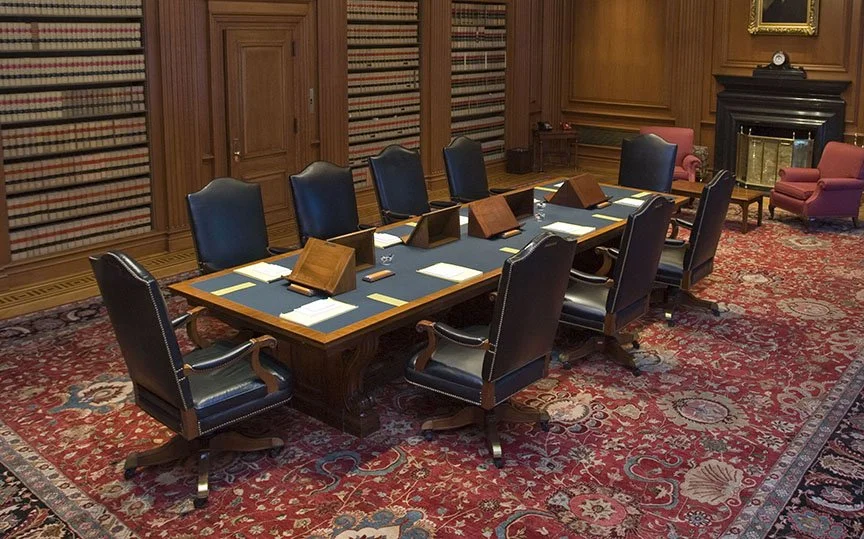
The Friday after oral arguments, the Justices meet in their private conference room to debate the cases presented. Each case is assigned to a particular Justice, who will write the Court’s opinion.
During these conferences, not even the Justices’ clerks are permitted in the conference room. The junior Justice (measured by the date of their appointment to the Court, not their age) serves as the physical gatekeeper of the door to the conference room. They are also tasked with other mundane duties, such as serving on the Court’s Cafeteria Committee, a duty initially assigned to Sandra Day O’Connor, the first female Justice.
For each case taken up at conference, the Chief Justice provides their thoughts, followed by each of the eight Associate Justices, in order of seniority. They then vote on the decision. If the Chief Justice is in the majority, they can assign the case for writing up the opinion to any Justice in the majority, including themselves. If not, then the senior Justice in the majority makes the assignment.
When the Court has a full complement of nine Justices, a majority opinion must garner at least five votes to become law and also a precedent for future cases. If the Court is not at full strength, a majority of the Justices participating in the case is required.
Justices are not shy about expressing their opinions and highlighting differences with their colleagues, but they do so mostly in respectful ways—unlike the veritable partisan food fights common in the Legislative Branch. Justices will often flatter each other’s draft opinions before legally eviscerating them. A few “suggestions” to a colleague’s draft opinion can run many pages and essentially replace key portions of their colleague’s work.
The marked difference between the Federal Judiciary and the other two branches of government is that disputes usually aren’t filled with virulent personal attacks. The Justices often forcefully disagree, but they tally these distinctions mostly in legal terms—although even these, at times, can be scathing.
Though they sometimes have very different jurisprudence (legal philosophies and writings), many Justices are close personal friends off the bench. A great example was the deep friendship between the late Justices Anthony Scalia and Ruth Bader Ginsburg. Though they often found themselves on opposite sides of major Supreme Court decisions, and often wrote powerful dissents, they made clear their respect for one another, and they frequently socialized together.
Types of Supreme Court Rulings
Once a case has been argued in Court and debated in conference by the Justices, there are three primary types of conclusive opinions SCOTUS can issue.
Majority Opinion: This requires a majority of the Justices to agree on both the outcome of the case, and the legal reasoning behind their decision. Most Majority Opinions become precedents for similar cases in the future.
Concurring Opinions: These are separate opinions offered by any of the Justices in the majority who agree with the result of the Majority Opinion, but not with the legal reasoning employed to reach this outcome. Concurring Opinions do not become precedents for future cases.
Dissenting Opinion: These are separate opinions offered by any of the Justices who disagree with the Majority Opinion. Dissenting Opinions can be joined by as many as four Justices in total. (Any number higher than that would make it a Majority Opinion.)
Supreme Court decisions may be released by being posted to the SCOTUS website, or by a Justice reading them aloud from the bench. When a dissenting Justice is particularly troubled by a Majority Opinion, they often choose to read their dissent aloud in a public Court hearing, sometimes with considerable passion.
If the Justices can't reach a decision on a case, they can choose to hold it over to their next term for reargument. This can happen when there is a tie vote, or when none of the opinions circulating can garner a majority. It can also happen if there is a need for clarification, or when there is a change in the composition of the Court (as when a new Justice replaces another who has retired or died). It can also happen if the Court is not at full strength, and the case involves a controversial subject that they feel would be best decided with a full complement of Justices.
This occurred in the 1973 landmark Roe v. Wade decision, which legalized abortion nationwide, before being overturned by the 2022 Dobbs v. Jackson Women’s Health Organization ruling. Roe v. Wade was originally argued in the Court's previous term, but there were only seven sitting Justices at the time. The Supreme Court believed this divisive issue should be decided once it had been returned to full capacity.
Each Supreme Court Justice is also assigned to a region of the U.S. for which they can hear emergency appeals. In such cases, the Justice usually won’t take permanent actions on their own if they believe their decision might be overruled by the full Court. They may sometimes grant brief administrative stays of rulings from a lower Court while the ruling is appealed.
The Unpredictability of Supreme Court Justices
Historically, numerous Presidents have been surprised by the rulings of their appointments across the Judiciary, including those to the Supreme Court. For example, in 1953, President Dwight Eisenhower nominated Earl Warren to the Court as Chief Justice. Formerly a district attorney, the Governor of California, and a candidate for Vice-President of the United States, Mr. Warren possessed strong law-and-order credentials. The Senate confirmed his appointment in a unanimous vote.
Chief Justice Warren served on the Supreme Court for 16 years, until his retirement in 1969. He turned out to be a staunch civil libertarian. He authored the 1954 Brown v. Board of Education of Topeka ruling, which made school segregation illegal. He also voted in the majority on other decisions that reinforced or expanded the guarantees of the 14th Amendment for the equal protection of all citizens under the law. These included many civil rights.
President Eisenhower was neither the first nor the last in his position to be surprised by a Justice he seated on the Supreme Court. In part, this comes from the nature of a lifetime appointment, as Justices can discharge their duties without fear of recall or of having to run in an election. The Framers of the Constitution intentionally set up the Supreme Court and all of the Federal Judiciary in this way, as they wanted Judges and Justices to make rulings based on the law, rather than on the vagaries of public opinion.
Increased Use of Shadow Docket
As mentioned above, the Supreme Court can take on expedited cases in emergency situations. When they do so, they bypass their regular procedures and can issue summary decisions that, while provisional, can still remain in effect for a year or more. University of Chicago Law School Professor William Baude coined the term Shadow Docket in referring to such cases, which allow for far less public visibility into these important judgements. Recently, the Supreme Court has significantly increased its use of the Emergency Docket, which has created debate in legal circles. This excellent U.S. News and World Report article explains the controversy and its importance.
Summing It Up
The Constitution provides the framework that established the basic structure, principles, and workings of our Federal government. The Framers did not intend it to be an exhaustive civil or criminal code for the country, which is why it developed the Legislative Branch, where Congress can pass new Bills; the Executive Branch, where the President can sign these Bills into law; and the Judicial Branch, where the Federal Judiciary, including the Supreme Court, can interpret these laws.
A central question regarding the interpretation of the Constitution is whether it should be taken literally, based on the views of the Framers at the time, more than two centuries ago. Supporters of the this view are often referred to as originalists. Others feel that the Constitution should be considered a “living document,” one that is continually updated and revised to reflect new information or the changing circumstances and values of the nation. This article describes the differences between these two judicial philosophies.
Unfortunately, the selection and confirmation of Supreme Court Justices, as well as of other members of the Federal judiciary, have fallen victim to the same partisan struggles that plague the other two branches of the Federal government. Not all that long ago, Supreme Court nominees were confirmed to the bench by wide margins, at times even unanimously. That is mostly not the case anymore. Both the judicial appointment and confirmation processes often devolve into bitter, hyper-partisan battles.
The nation would be better served if this one branch of government that is the ultimate arbiter of the rules we live by could resume its historical place as being largely above the political fray. The current perception by many that it is not provides further vindication of George Washington’s strong warnings about the inherent divisiveness of partisan warfare.
Once again, George Was Right.

Answer to the Did You Know…? Question
The answer is B) 116.
As of July 2025, 116 Justices have served on the Supreme Court since its establishment in 1789. There have been 17 Chief Justices and 104 Associate Justices. (The total of these two numbers is not 116 because five Associate Justices have gone on to serve as Chief Justice.)
Of the 116 Justices on the Supreme Court, only six have been women. Four of these women are currently sitting on the Court.