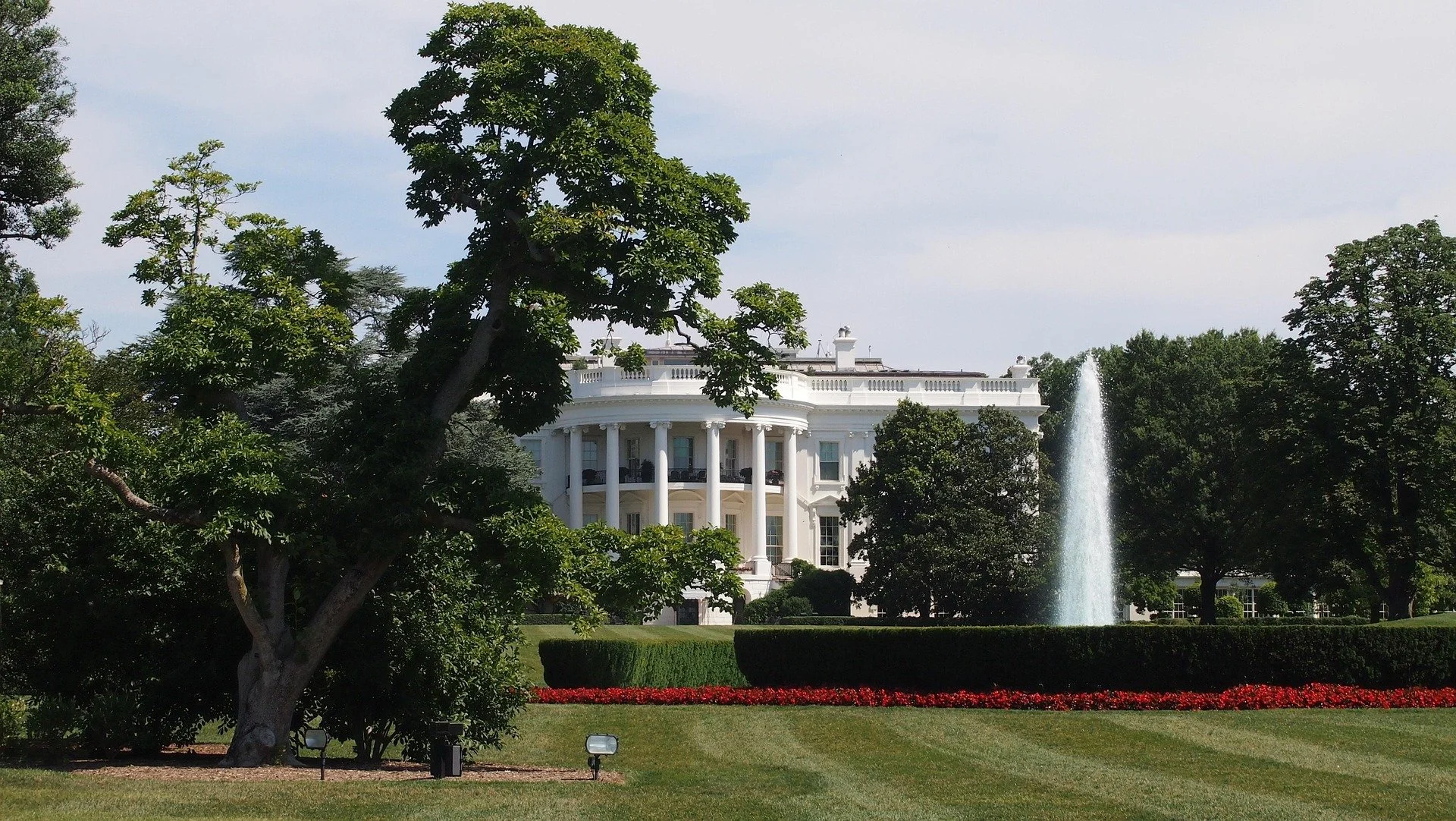
Executive Branch
““If your actions inspire others to dream more, learn more, do more and become more, then you are a leader.”
— John Quincy Adams
Overview
As discussed in Three Branches of Government, the fundamental responsibility of the Executive Branch is to enforce Federal Laws. Other obligations include conducting diplomacy and leading the military. It includes the President, Vice President, the heads of Executive Departments (who are collectively known as the Cabinet); and the staffs of those departments and various other agencies.
President
The President serves as the leader of the Executive Branch, and functions as both the Head of State and the Commander in Chief of the Armed Forces. The President’s powers are defined under Article II of the Constitution. With the passage of the Twenty-Second Amendment in 1947, Presidents can serve only two full, four-year terms. In the specific circumstance when a President succeeds to the office because of a vacancy—which could be caused by the death, resignation, or impeachment and removal from office, of his predecessor—then if the new President fulfills less than two years of their predecessor's unexpired term, they can still serve two full, four-year terms of their own.
Presidents have large personal staffs, including their Chief of Staff and their Communications Director, as well as many deputies and special assistants. Some are experts in particular policy areas, while others are just staff assistants. Most lower-level staff members and appointees do not require Senate approval, and they can be dismissed by the President at any time, for any reason.
According to the Constitution, Congressional approval is required for declarations of war, but in recent years, many Presidents—acting as Commander in Chief—have not sought such approvals, and Congress has been reluctant to challenge their actions. The last time a President received Congressional approval to declare war was during World War II. For some smaller but still significant conflicts, Presidents have requested and received from Congress authorization for the use of force.
Vice President
Vice Presidents have a unique role in the Federal government. They are the only elected official who actually serves in more than one branch. In the Executive Branch, though they have no defined duties, they are the first in the line of Presidential succession. Should the President become incapacitated or die, resign, or be impeached and removed from office, the VP would assume the presidency. As of 2026, nine Vice Presidents have done so: eight because of the death of the President, and one because the President resigned from office.
In the Legislative Branch, the Vice President serves as President of the Senate. They have the authority to preside over the Senate’s sessions, though modern-day VPs seldom do so. Their key Constitutional duty is to cast a deciding vote when the Senate is deadlocked.
The Vice President also presides over the joint session of Congress to count electoral votes after Presidential elections. In recent years, significant controversy arose over the VPs role in certifying the Electoral College vote. Congress subsequently passed legislation that clarified this procedure.
The Constitution provides no other responsibilities for the Vice President. In practice, a President can give their VP substantial duties and allow them a major voice in the decision-making process, or a President can have their second-in-command assume a lesser role, such as attending state funerals and the like. The decision can be made as the result of the Vice President’s relationship with the President. Some VPs are personally close to the President before their selection, while others are placed on the ticket for their ability to help the Presidential candidate win particular States.
Did You Know…?
As of 2026, there have been 45 different Presidents. How many different Vice Presidents have there been?
A) 45
B) 50
C) 55
D) 57
You can find the correct answer at the bottom of this page.
The Cabinet and Other Staff
The President’s closest official advisors are Members of their Cabinet. The number of such officials can vary, as the President has the authority to determine whether or not certain positions are given that rank. The Cabinet always includes the Vice President and the heads of the 15 Executive Departments. These officials are traditionally given the title of Secretary, other than the head of the Department of Justice, who is known as the Attorney General, and the head of the Department of Health and Human Services, who is known as the Surgeon General.
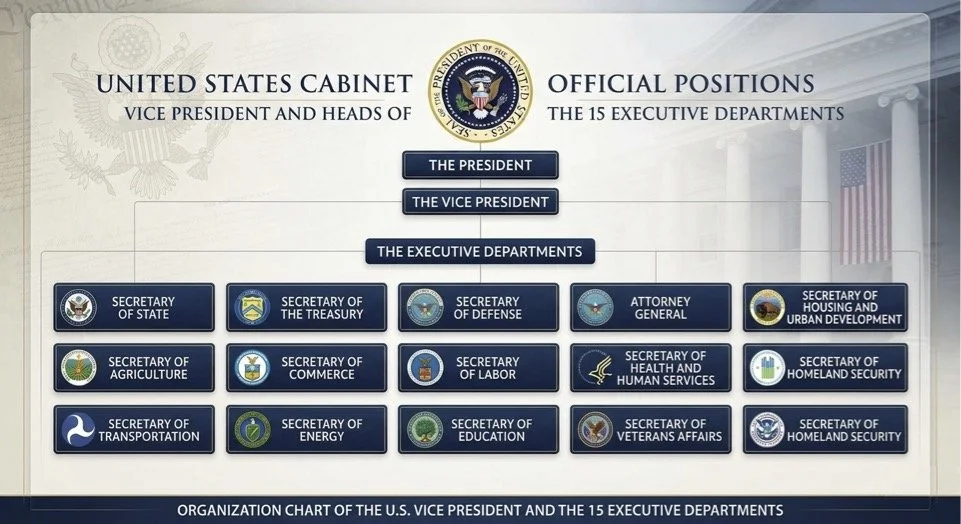
Other senior officials can be designated by the President as Members of the Cabinet. These can vary by President. Below is a graphic showing all of the positions that have at one time or another been afforded Cabinet-level rank by at least one President.
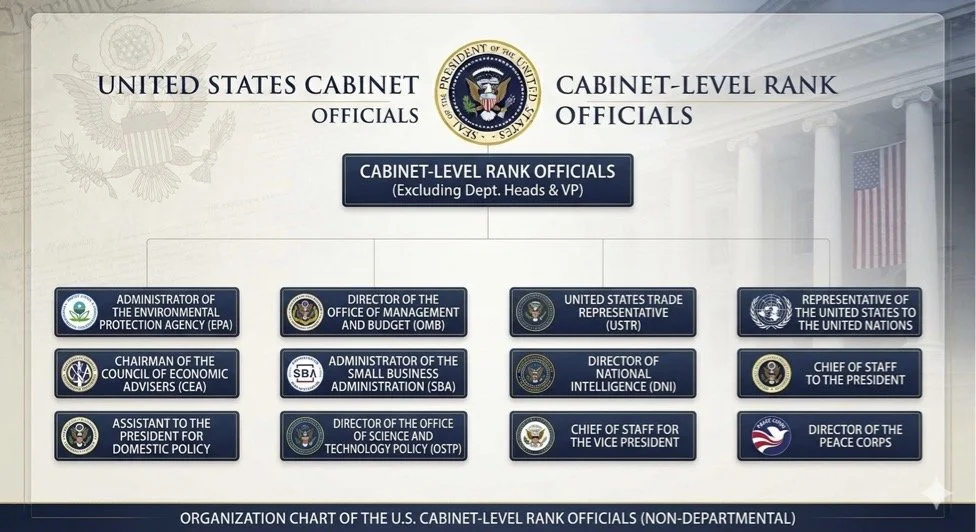
Members of the Cabinet, as well as some high-ranking deputies (often known by the title Deputy Secretary), must be confirmed by a majority vote of U.S. Senate. They can be fired by the President at any time and for any reason, though they can only be removed by the Senate through the same impeachment process utilized to remove the President, Federal Justices, and Federal Judges.
The Federal Budget
The President is responsible for proposing the first draft of the country’s budget. From a practical standpoint, though, such proposed budgets are often considered dead on arrival when introduced to Congress. The House and Senate often rewrite the budget to reflect their own priorities.
The Federal budget is supposed to be passed by Congress via a series of appropriation bills that fund different parts of the government. But in recent years, Congress has rarely passed the necessary appropriation bills, opting instead for emergency spending bills, called continuing resolutions (CRs), largely keeping expenditures the same as the previous year in order to keep government funded.
Failure to pass even these emergency measures have threatened or actually resulted in partial shutdowns of the Federal government. Such showdowns between the President and Congress have sadly become a routine experience in recent years.
Summing It Up
The Framers of the Constitution structured the three branches of government as co-equal, in an attempt to avoid the concentration of power that had arisen in the British system from which they declared independence. But these days, are the three branches still really equivalent in power? Here’s where things can get murky. The answer to the question really depends upon how much each branch chooses to assert its powers. Some feel that the Supreme Court’s 2024 conveyance of Presidential immunity for official acts has contributed to political overreach and the diminishment of the checks and balances in our system.
Maintaining that system of checks and balances has become increasingly questioned when it comes to the use of military force. Congress has generally played a more passive role in foreign policy, ceding a good deal of their influence in this area to the President. At the same time, Presidents have been accused of overstepping their Constitutional powers by, among other things, issuing executive orders for actions that some feel should require Congressional approval.
Undoubtedly, what would go a long way towards making government work better for the people would be for officials to adopt an atmosphere of greater trust, a willingness to seek bipartisanship, and a commitment to achieving consensus. And we can all do without the constant drama.
Though many question its practicality and effectiveness in today’s political environment, the ultimate power to make change still lies with the people. With even a modest effort to be more selective about who and what we vote for, as well as taking a greater interest and role in our democracy in other ways, much could be accomplished in DC and our State capitols.
Much more on this and others aspects of our political system either is available on GeorgeWasRight!
Answer to the Did You Know…? Question
The answer is B) 50.
The reason that the number of different Vice Presidents is not the same as the number of Presidents is that some Presidents have had more than one Vice President (because of deaths, resignations, or changing political tickets from one election to the next); some Vice Presidents have served more than one President; and some Presidents have served their entire terms without a Vice President.
Prior to passage of the Twenty-Fifth Amendment in 1967, the Constitution did not provide a means of filling a vacancy in the office of the Vice President. When a President died, the Vice President assumed the position, leaving the Vice Presidency empty until the next election. Over the course of U.S. history, this has left the country without a Vice President for approximately 37 total years.