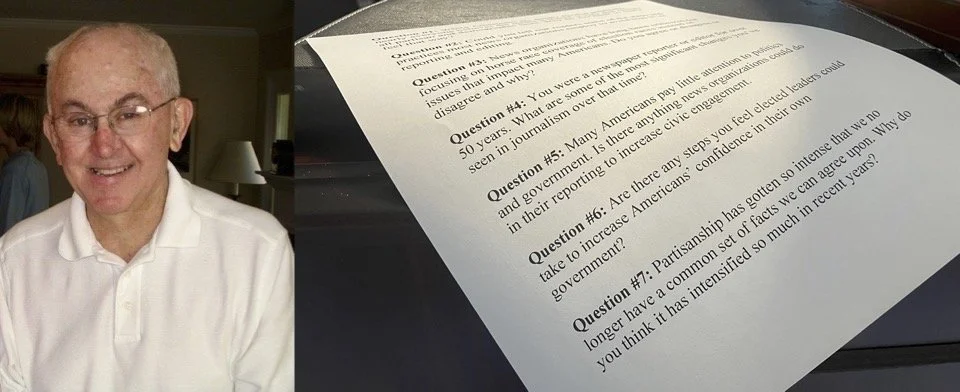
Interview: William Endicott
In a distinguished career spanning more than 50 years, Bill Endicott served as both a reporter and an editor. He worked for the Los Angeles Times and the Sacramento Bee, including time both as the Capitol Bureau Chief and as the Deputy Managing Editor for the Bee.
This interview was completed on June 12, 2025.
Introduction
GeorgeWasRight: Welcome, Bill, and thanks so much for taking the time for this interview.
William Endicott: I’m glad to join you, thanks.
Media Bias
GWR: While Americans are deeply divided politically, nearly everyone believes the media is biased, a view that crosses all partisan and demographic lines. Why do you think so many feel that way?
WE: Nothing new about this. Readers tend to think that anything that does not confirm their own biases is biased. There also is a problem with readers equating editorial pages with news. If, for instance, a paper endorses one party’s candidates, many readers assume that news coverage is likewise slanted toward that party.
Reporting
Safeguards
GWR: Could you tell our readers some of the steps and practices most news organizations employ to avoid bias in their reporting and editing?
WE: This requires strict editing standards. Unfortunately, with so many cuts in newsrooms, editing sometimes seems nonexistent. No magic bullet.
GWR: Acknowledging what those huge cutbacks have caused, can you describe a few key practices to filter out bias and inaccuracies, like having multiple editors go over a story before it is published?
WE: There was a time when a story would go through at least three editors before reaching print: the metro editor or bureau chief, the news editor, and the copy desk. The Internet changed all that. The pressure to get online first now often results in reporters filing directly to a website with little or no editing. Bias and/or inaccuracies then are caught and sometimes corrected only after stories are already in the public domain. I don’t see that changing.
Horse-race
Coverage
GWR Note
GWR: News organizations have long been criticized for focusing on horse-race coverage of election races instead of issues that impact many Americans. Do you agree or disagree, and why?
WE: Completely agree. There is too much emphasis on polls taken months, if not years, before an election. But it’s a lazy way to cover politics, and news organizations that do polling feel compelled to play them up.
GWR: As a longtime pollster, I can tell you some other reasons for treating poll results with caution and restraint these days: the very low response rate to taking them, and the fact that many are being done or sponsored by those with partisan or other influences.
Changes in
Journalism
GWR: You were a newspaper reporter or editor for more than 50 years. What are some of the most significant changes you’ve seen in journalism over that time?
WE: The most significant change, I believe, is the proliferation of news sources, and the corresponding growth of social media. The loss of ad revenue to the Internet has forced huge cutbacks on newspaper staffs, with a corresponding loss of readership.
GWR: Does having partisans or ideologues who present themselves as objective journalists or news organizations make it difficult for the public to differentiate between the two?
WE: Absolutely. Once again, readers and/or viewers are unable to make the distinction, and confuse news with commentary.
Civic
Engagement
GWR: Many Americans pay little attention to politics and government. Is there anything news organizations could do in their reporting to increase civic engagement?
WE: Doubt it.
GWR: Wouldn’t, say, placing more emphasis on explaining stories in ways that would be more helpful to folks who don’t follow politics closely, and how they can engage on the issue more broadly, be helpful?
WE: The answer to that is, “Obviously.” And there are websites, such as CalMatters.org, that attempt to do that. But longform explanatory journalism requires experienced and knowledgeable staff. Buyouts and layoffs in mainstream media are taking their toll on that experience.
Confidence in
Government
GWR Note
GWR: Are there any steps you feel elected leaders could take to increase Americans’ confidence in their own government?
WE: Policing themselves is a nonstarter and, right now, respect for Congress and the Supreme Court are at all-time lows. These are self-inflicted wounds, and given the bitter partisanship that has gotten worse in recent years, I see little chance of changing that.
GWR: While partisanship has increased substantially, the problems it presents date back to revolutionary times, when Washington warned us of their inherent divisiveness. Given how much information is just a “Hey, Siri” away, voting primarily by party seems a bit dated today.
Increased
Partisanship
GWR: Partisanship has gotten so intense that we no longer have a common set of facts we can agree upon. Why do you think it has intensified so much in recent years?
WE: See my answer to the previous question, adding to it the polarizing effects of cable news shows and social media.
Unrepresentative
Representation
GWR Note
GWR: Congress is unrepresentative by gender, race, income, and especially by partisan affiliation or lack of affiliation. Though more than a third of Americans now consider themselves independents, they hold fewer than one percent of the seats in Congress. Why do you think that’s the case, and what can be done about it?
WE: Gerrymandering is one culprit, but other than that, I have no idea.
GWR: I don’t think that mismatch can continue indefinitely as the percentage of unaffiliated voters continues to rise, especially among young people. Candidates no longer need the backing of a party or of special interests, since they can raise enough in small contributions to be competitive now. If even just a few independents use this model and win, many more will likely follow.
Expensive
Elections
GWR Note
GWR: Nine of the ten most expensive Senate races of all time took place in the 2020 elections. More than a quarter of a billion dollars was spent on each of three races. Do you think our democracy is basically for sale to the highest bidder(s), and can anything be done about it?
WE: For starters, reversing the Supreme Court Citizens United decision that opened up unlimited campaign contributions. There is no question that money buys both access and influence.
GWR: Given that and other Supreme Court rulings that have enabled dark money and other ways to contribute unlimited sums to candidates, perhaps we would be better off on focusing on teaching voters how they can follow the political money trail, which is actually pretty easy if you know where to look.
Wrapping It Up
GWR: Wrapping it up, do you have any other thoughts on how we might get out of the downward political spiral we seem to find ourselves in?
WE: Again, no magic wand. Electing better people is easier said than done. As long as we continue to elect people more interested in power and/or showmanship than policies that might advance the American experiment, we are in trouble.
GWR: Thank you so much for taking the time to share your thoughts with GeorgeWasRight!