
Why Independent Voters Matter in the 2026 Midterm Elections—and Beyond
“Our political leaders will know our priorities only if we tell them, again and again, and if those priorities begin to show up in the polls..”
— Peggy Noonan
Rising Frustrations
It can often be challenging to perceive even a rough national consensus from an examination of how people vote in any particular election. In addition to the risk of generalizing the results to discern the overall will of voters, election results are subject both to interpretation and political spin. Still, in some cases, how an election turns out can occasionally be a bellwether of things to come. The 2026 midterm elections may be one of those times.
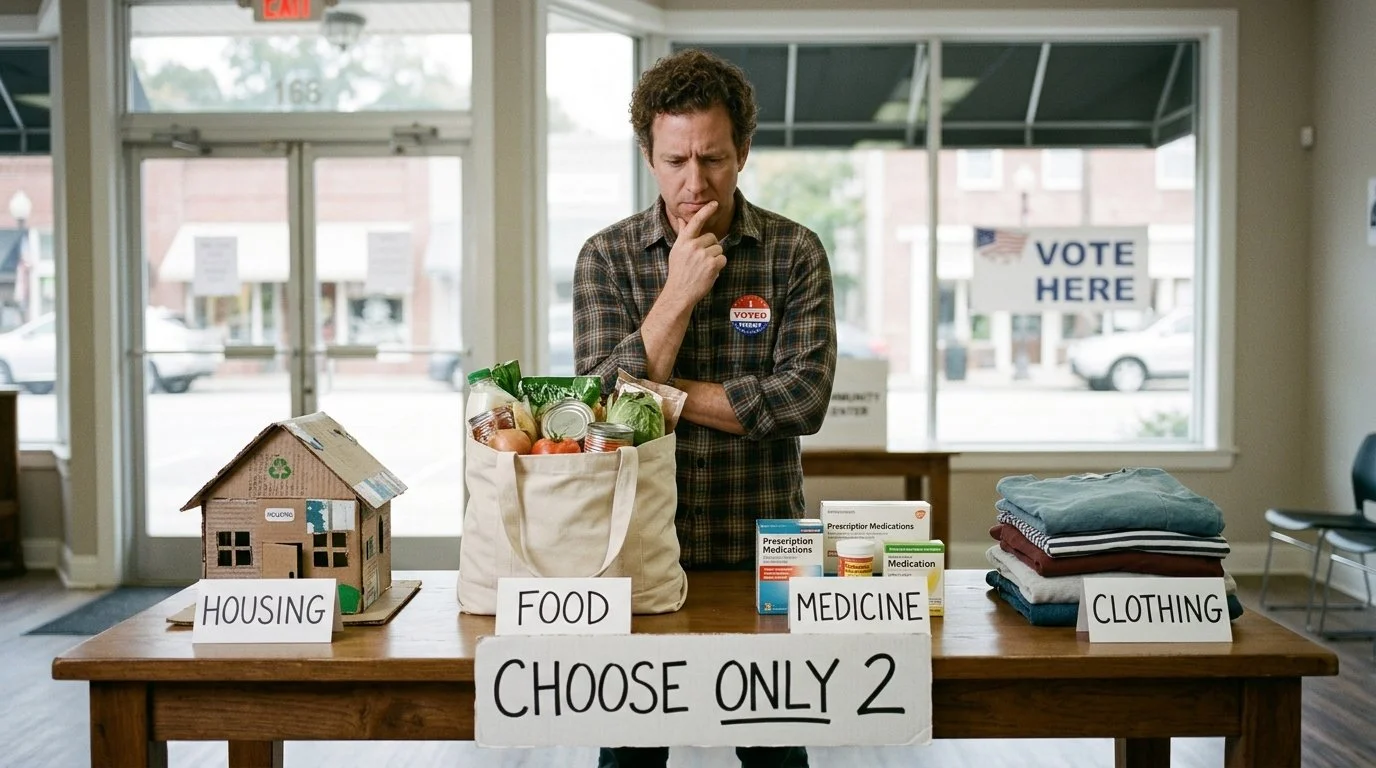
Driven by boundless partisanship, and caused by a government long and increasingly owned and controlled by special interests, the cumulative weight of these burdens has had a crushing effect on the American Dream, transforming it into a nightmare on Main Street. For many these days, affording even the basic necessities of life—a decent place to live, food, health care, utilities, fuel, and the like—has become an ongoing series of difficult choices and painful trade-offs.
But people can juggle only so much before they can’t. While serving in the U.S. Senate, eventual-President Harry Truman summed up the political frustration of that era in his own plainspoken way: “People can stand only so much, and one of these days there will be a settlement…”
Major settlements like that often take a great deal of time to come to fruition. Transforming a dysfunctional government into one resembling the type of which President Lincoln spoke—of, by, and for the people—will require many elections. Still, one major discrepancy between the makeup of the people and their elected representatives may begin to get addressed in the upcoming 2026 midterm elections.
Since data regarding the party affiliation of voters is collected differently from one State to another, estimates of the national partisan breakdown is typically accomplished through polling. Consequently, the percentage of voters registered to specific political parties will be in the ballpark, but is also subject to larger potential error than the examination of direct data. Keeping that in mind, Independent voters—those who choose not to identify with any party—now make up nearly half of the electorate. At the same time, Independents have scant representation in Congress. None of the 435 Representatives in the House, and only two of the 100 Senators, are Independents. Across both Chambers of Congress, that’s two out of 535 elected officials, or about a third of a percent.
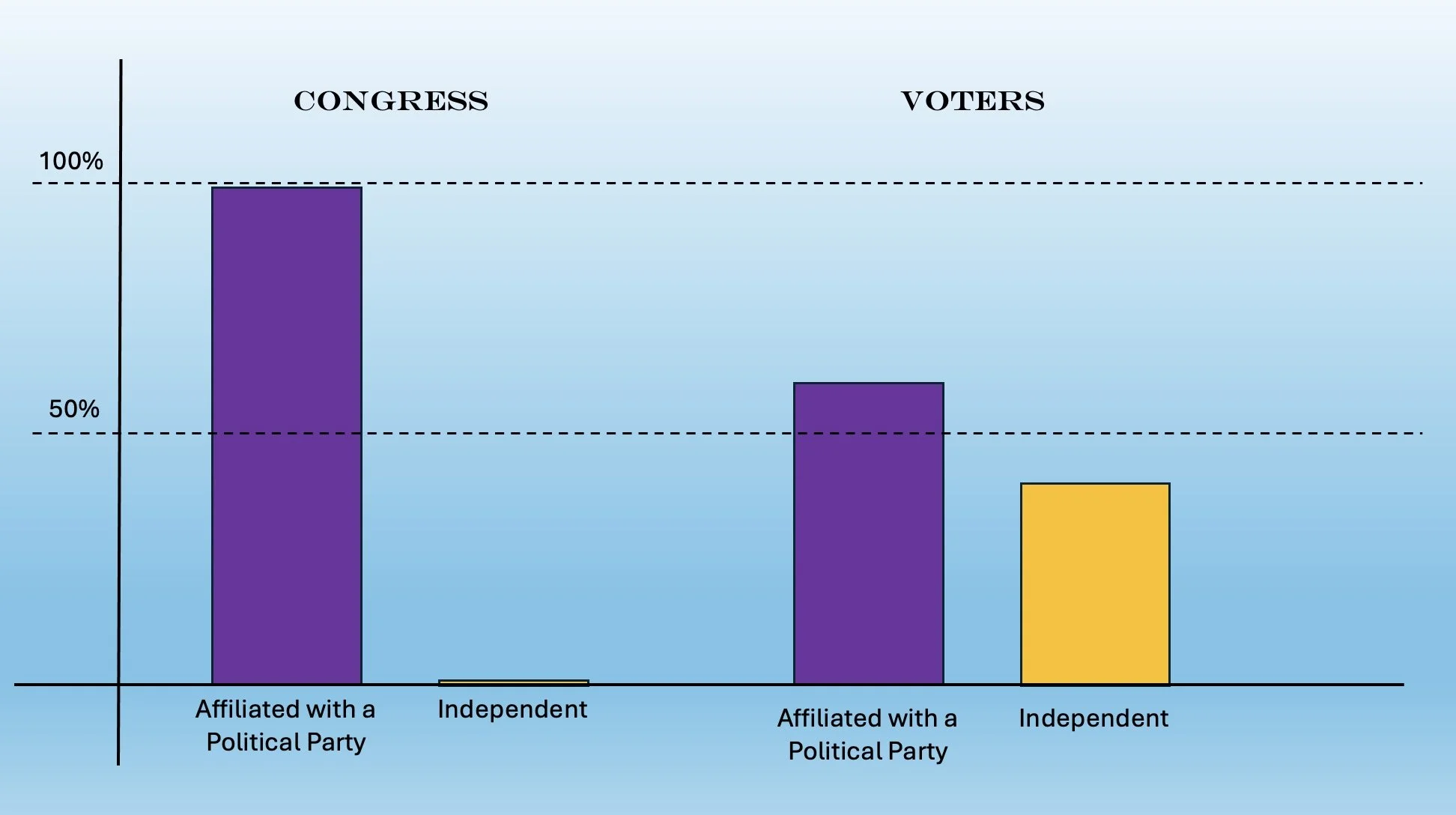
In the 2026 midterm elections, only one Independent candidate is running a competitive campaign for Congress (in the Nebraska Senate race). That means that the results of these elections will not fundamentally alter the balance of power between partisan and nonpartisan representation.
At the same time, the long-term impacts of the growing number of Independent voters may begin to be seen in these elections. Such measures as the number of Independents who turn out to vote, as well as the candidates for whom they cast their ballots, will be accurately captured by exit polling.
In the last 100 years, the record for voter turnout in midterm elections occurred in 1966, when a national average of 55.4% of the electorate voted. If that number is surpassed this year, it could be another sign that voters are getting more engaged, and that they are increasingly done with the status quo of our political party duopoly.
Independents in other fields related to politics may also affect these and future elections. One such impact may be in how voters obtain information about elected officials, other candidates, and ballot measures. The widespread public distrust of legacy media, massive layoffs and cutbacks in news coverage, the consolidation of news outlets from more than a hundred to just a handful, have contributed to the creation of a new age of independent journalists. And that’s a good thing!
Did You Know…?
The highest voter turnout for midterm elections in American history occurred in 1866, when it reached 71.4%.
In the wake of the Civil War, which ended the previous year, the participation of such a high percentage of the electorate was driven by several factors. With the abolition of slavery, political battle lines were drawn as different factions attempted to control Reconstruction. Some wanted leniency for the States that had formed the Confederacy, while others wanted punishment. Some wanted to establish and protect the rights of newly freed African Americans, while others sought to limit such rights.
All over the Internet, you’ll find faces and voices you may recognize from their time with higher-profile news outlets, but who are now doing great long-form reporting as independent journalists. In-depth investigative reporting done by nonprofit news organizations—such as ProPublica—also make it easier to become better informed about the inner workings of politics and government, and to identify the bad actors within them.
Many Americans largely tune out coverage of politics and government, feeling that nothing ever changes, regardless of who gets elected. The constant barrage of mostly negative campaign ads funded by dark money and other deep-pocketed independent expenditure groups are an irritant that leaves many either diving for the mute button or simply changing channels.
In a time when vast amounts of knowledge are a “Hey, Siri” or other search away, relying on political parties to inform us about who we should vote for seems decidedly dated. Most of us use today’s online tools to help choose much of what we do or buy, yet we still mostly vote along party lines instead of checking out individual candidates. This, in turn, empowers lawmakers to continue doing what they’re doing, regardless of what the public wants them to do.
In order to convince elected officials to serve their constituents, rather than themselves or special interests, we need to demonstrate that we will vote based on the actions and inactions of those officials, rather than based on their party affiliation. That means we need to expand the election criteria we employ beyond just party. With the advent of tools like the Internet, coupled with the availability of information provided by independent reporting, that’s not difficult to do. For example, GeorgeWasRight provides a simple guide that will allow you to quickly learn who is financing individual candidates and ballot measures. That’s valuable information, which should influence who and what you vote for.
Summing It Up
The growing movement of American voters away from party membership is irreversible. Why? Because many, if not most, younger voters choose not to affiliate with them. Of course, political parties will not simply go away. So rather than labeling the future as a post-party era, let’s say that we are entering a past-party era, when their power will gradually diminish as younger voters shun them. Over time, Independents will gain more power, both as voters and as elected officials.
It will take numerous elections for these potential changes to become a reality. The results of the 2026 midterms, though, may eventually be viewed as the first chapter of a long book about how Americans, in totally peaceful ways, took back control of their government and restored it to being of, by, and for the people.
If George Washington could see these changes happen, we would likely see his famous smile, reflecting his knowledge that the freedoms for which he and the other Framers fought remain, even 250 years later!