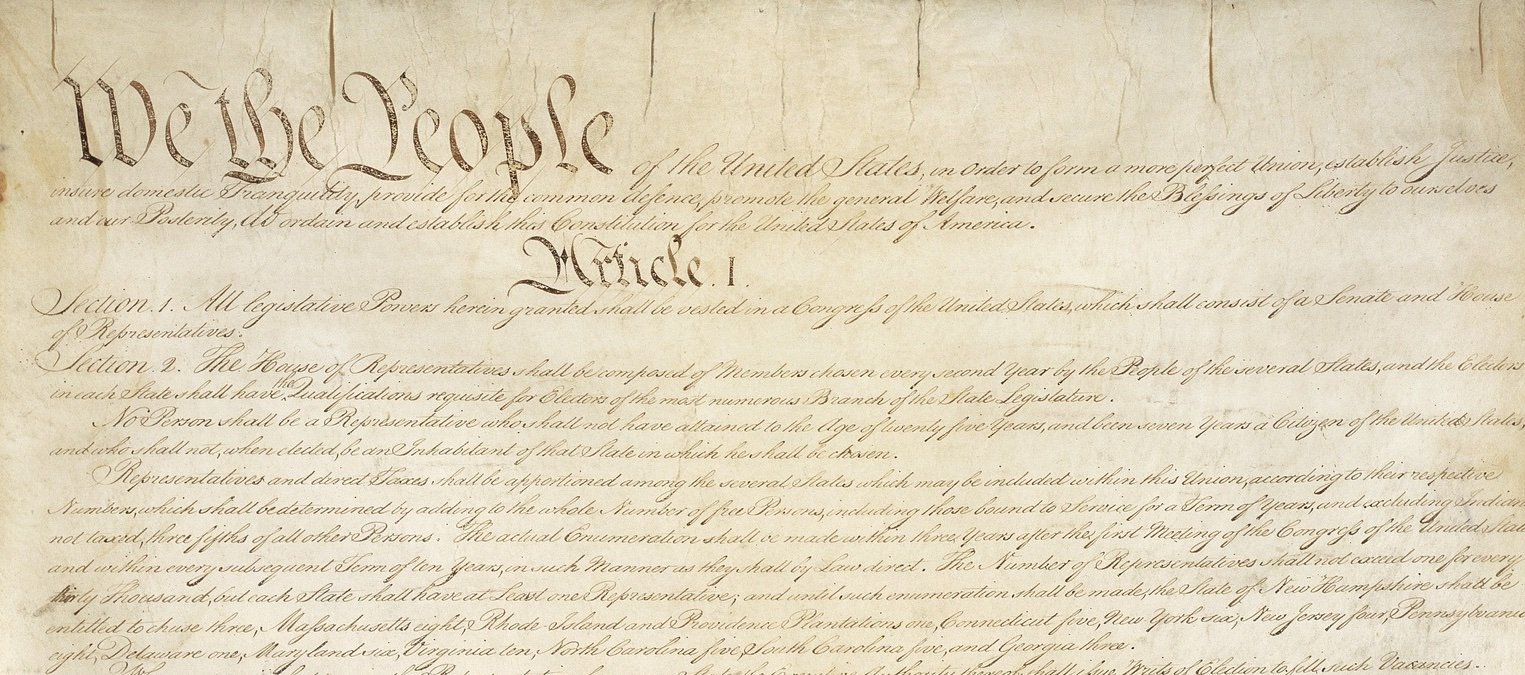
Basics of the Constitution
“In questions of power, let no more be said of confidence in man,
but bind him down from mischief by the chains of the Constitution.”
— Thomas Jefferson
At its core, the United States Constitution is the fundamental legal document of the country. It establishes the structure of the nation’s government, divides powers between the Federal and State governments, and protects the basic rights of citizens. When an elected Federal official takes their oath of office, they do not pledge to pursue the needs of their home state, or to work for their own benefit or those of special interests, but to protect and defend the Constitution. (Whether or not politicians actually do that is entirely another ballgame.)
The National Archives in Washington, D.C. does a great job of explaining our nation’s founding documents, including not just the Constitution, but also the Declaration of Independence and the Bill of Rights. They’re worth checking out if you’re not familiar with them, or even if you just haven’t looked at them in a long time. So too are the Federalist Papers, a series of essays describing the necessities and options the Framers of the Constitution considered in forming our government.
The Constitution was not the first attempt at creating laws for our new nation. That distinction is held by the Articles of Confederation, passed by the Second Continental Congress in 1777, and ratified by all 13 state legislatures in 1781.
The laws detailed in the Articles gave nearly all power to the States, providing only for a weak central government. There was little interest in creating another strong, centralized ruling body. After all, the American colonists were rebelling against England in part because it had such a system.
But the limited powers that the Articles of Confederation conveyed to the Federal government lacked even the power of taxation to fund it. This and other deficiencies led to the Constitutional Convention of 1787 and passage of the first parts of our permanent Constitution later that year.

The Constitution consists of a Preamble (“We the people...”); seven Articles, which outline the powers of the Executive, Legislative, and Judicial branches of government, along with other procedures and functions; and, as of 2025, the 27 Amendments later added.
When passed in 1787 and ratified by the requisite number of States in 1789 (a two-thirds majority, which at the time meant nine of the 13 states), some worried that the new Constitution didn’t adequately address key rights of individuals. As a result, in 1791, Congress passed the Bill of Rights, which contains the first ten Amendments, spelling out many of our most important freedoms, including the freedom to practice religion, freedom of speech, freedom of the press, the right peaceably to assemble, the right to petition the government for a redress of grievances, the right of the people to be secure in their persons, and protection against unreasonable searches and seizures. It also declares that all powers not specifically granted to the Federal government are reserved to the States.
Though you may be familiar with it, the Bill of Rights is really worthy of rereading and reflection. The 17 later Amendments are also important. They lay out other key rights, and also offer a good window into our country’s changing values.
The Fourteenth Amendment, in particular, is one with which you should be familiar, as among other things, it guarantees equal protection for all under the law. It has been the basis for many judicial decisions that rejected laws failing to meet its requirements.
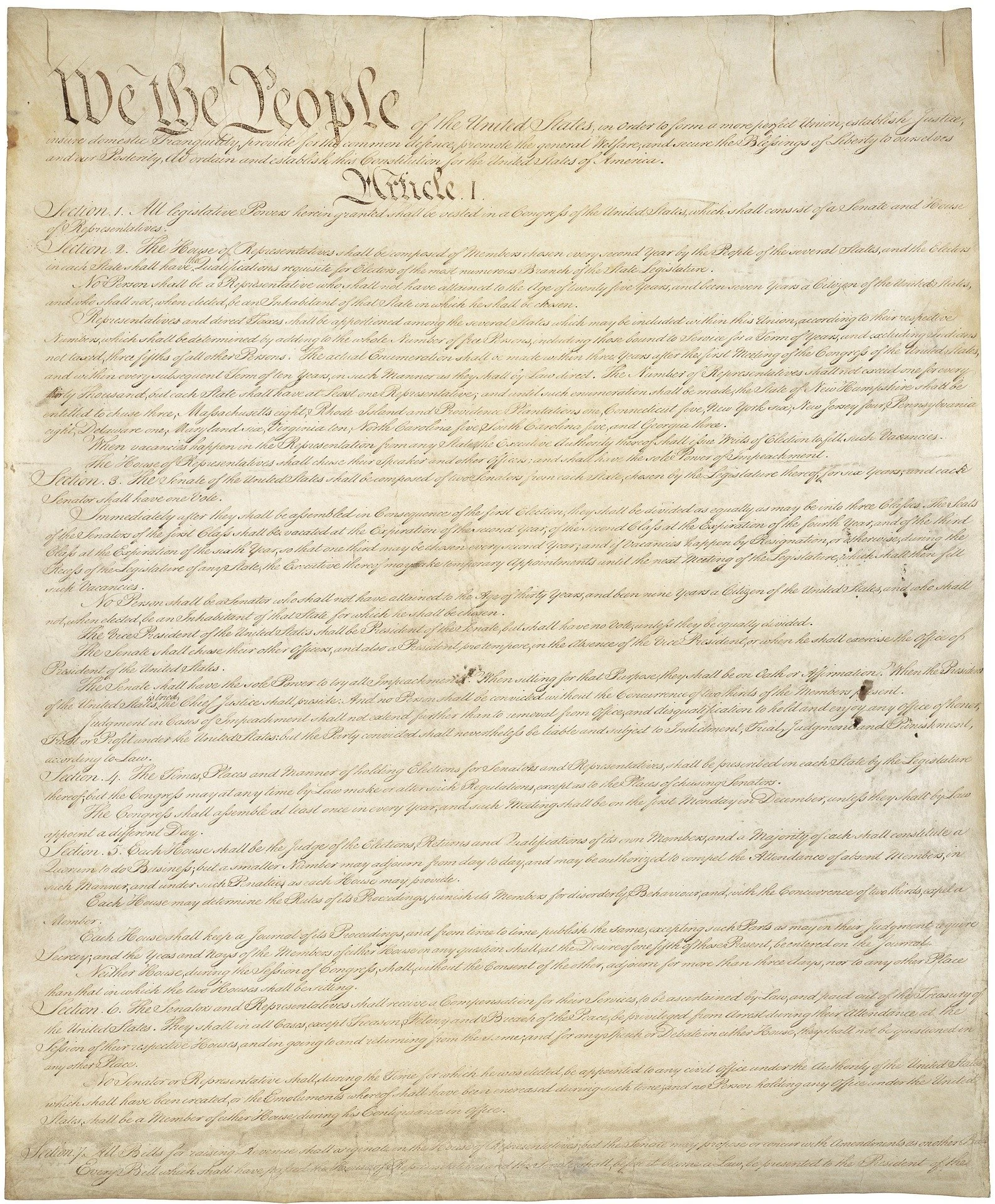
Federalism — Divided Power, Checks and Balances
The Constitution divides Federal power by creating three coequal branches of government. The Executive branch enforces laws, the Legislative branch makes laws, and the Judicial branch interprets laws and ensures that they do not violate the Constitution. In addition, the Constitution provides a system of Checks and Balances, which allows for the different branches to influence or limit the others. The principle paramount to the Framers exemplified by this system is that no single branch of government could become more powerful than any other.
The ability for Congress to make laws and the President's ability to veto them, or the power of the President to nominate Federal Judges and Justices, but the need for the Senate to confirm them, are just two good examples of these checks and balances.
So too was establishing a system of Federalism, with Federal, State, and Local governments, that diversified power and let people live in communities with local laws that they supported.
For example, I once lived in a small town that wanted to keep it that way. So the City Council approved a measure banning large franchises from operating there. But it wasn't a big problem if you craved a burger or something else from a national chain. Any number of them sat just outside the city limits.
Federalism establishes a hierarchy of national and regional laws. Looking at one state, California has, from top to bottom, Federal, State, County, City, and Special Districts (for specific purposes, such as providing water and sewer service).
In a Federalist system, each level of government can enact laws within their jurisdiction, but must also comply with the laws of all levels of the governments above them. For example, a city or county can pass a law (usually called an ordinance at the local level), but it must also comply with all Federal and State laws.
Most conflicts occur between Federal and State laws. The Supremacy Clause of the Constitution gives Federal laws priority when there's a conflict between the two. However, the President also has the option of not aggressively enforcing a conflicting Federal law, which they would do through Federal agencies.
Since the COVID-19 pandemic, we've seen conflicts between some State and Local governments, mostly over mandated safety restrictions. Some Governors banned more restrictive measures taken by Local governments in their state.
Did You Know…?
How many words are in the Constitution, including all of the Amendments?
A) 7,500
B) 17,500
C) 27,500
D) 37,500
You can find the correct answer at the bottom of this page.
Amending the Constitution
Article V of the Constitution lays out the process for amending it. The Framers established a high bar for doing so because they didn't want it easily changed to meet the mood of the day.
Amending the Constitution is a two-step process. Proposed Amendments must first be passed by two-thirds majorities of both the Senate and the House of Representatives. If successful, the Amendment is then sent to the 50 State legislatures, where three-quarters of them (38 states) must ratify it in order for it to become law.
Though it has never been done, the States can bypass the three-quarters ratification threshold by having two-thirds of the State legislatures demand a new Constitutional Convention.
The high bars to passage have been successful in limiting the number of new Amendments passed. In over 200 years, the Constitution has only been amended 27 times, a number that includes the 10 Amendments in the Bill of Rights.
With political divisions so high today, it’s difficult to envision any proposed Constitutional Amendment receiving the requisite majorities required to make it law. For example, it took more than two centuries to ratify the 27th and most recent Amendment in 1992—all that for a change over when Congressional pay raises go into effect.
Even ideas like women having the same rights as men couldn't clear the high Amendment bar. The Equal Rights Amendment, passed by both chambers of Congress in 1972, failed to receive ratification by the necessary 38 states. Only 35 states ratified it.
The idea of eliminating the Electoral College in favor of a national popular vote is itself broadly supported, with one poll showing 65% in favor of the idea. Popular or not, it’s hard to get two-thirds of the Congress to agree on anything, much less a major change to how we elect our Presidents. Even if such a legislative miracle occurred, the chances of getting three-quarters of the State legislatures to agree to this change would be even worse. States with lower populations benefit from the current Electoral College system, and most would be very reluctant to give it up.
Summing It Up
The Constitution was written as a framework for establishing the basic structure, workings, and principles of our new government. It was never intended to be the definitive civil or criminal code for the country.
A central question about interpreting it is whether it should be taken literally, based on the views at the time of the Framers, or more of a living document, the interpretation of which should change as times and values change.
As our partisan divisions make it very unlikely any Amendment will gain sufficient support for passage in the near future, where does that leave us in terms of updating the laws we have?
Congress can still pass laws that require only the President’s approval, or the necessary two-thirds vote to overcome a presidential veto. Given the 60-vote hurdle the Filibuster poses in the Senate, the odds of passing new laws, even those with broad popular support, are not promising.
As far as State issues, where you live is becoming increasingly important in terms of the laws you live by and the prospects for changing them. Those who live in States with direct democracy, that permit initiatives to be placed on the ballot simply by gathering enough signatures of citizens, have the option of bypassing State legislatures dominated by special interests.
While the Framers did not believe in offering direct democracy on a national level, giving States and Localities the ability to do so created something of a workaround from tyrannical or ineffective government.
So even with a gridlocked Congress, we can still get plenty done. The independence of State and Local governments, plus the options for direct democracy in many states, are likely the most realistic paths for political change, at least for the time being.
We've reached a governing fork in the road. Do we keep moving blindly forward until we hit the wall of cans lawmakers kicked there, or do we choose to become more discerning about who we choose to represent us, and more involved in public decision-making in other ways?
You might find the Is Government Us or Them? post useful in thinking about this question.
You can also click these links to read the full text of the Constitution, the Declaration of Independence, and the Bill of Rights.

Answer to the Did You Know…? Question
The answer is A) 7,500.
The U.S. Constitution has only 7,591 words in total, including not only the 27 Amendments, but also the names of those who signed it. Pretty tight for a document of its weight!
And here’s a likely winner for a political trivia contest: George Washington’s Farewell Address to the Nation was actually a few words longer than the entire Constitution, including all of the Amendments passed so far. He could go on a bit, but his words are so worth reading.