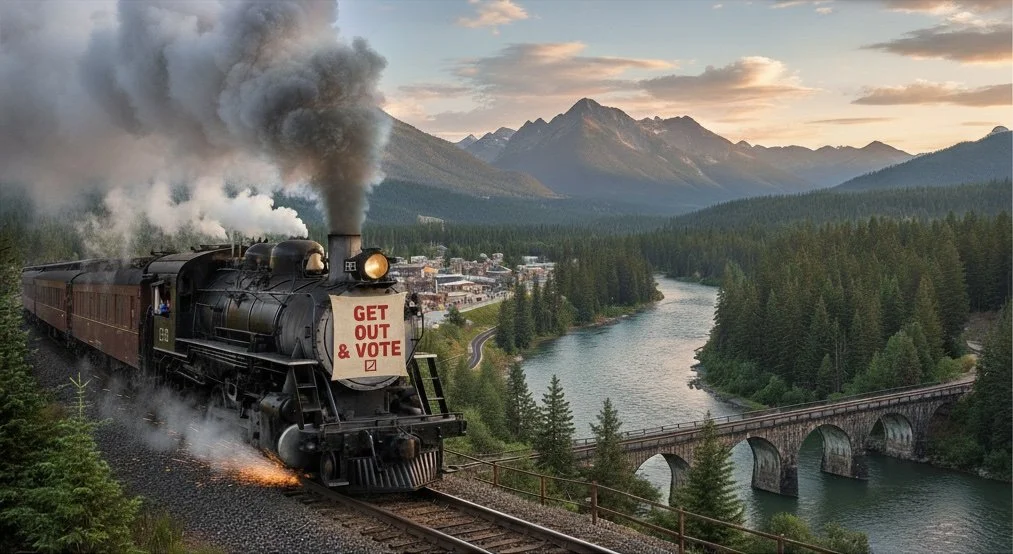
Rallies Along the Rails
“I went by train. I wanted to talk to them face to face. I knew that they knew that when you get on television, you’re wearing a lot of powder and paint that somebody else has put on your face, and you haven’t even combed your own hair.”
— Harry Truman
Rolling Back in Time
For all the micro-targeted, Internet-spanning, consultant-driven political campaigns we’re forced to endure these days, it’s worth revisiting a simpler, more personal method national candidates used to employ to reach voters. Today’s media bombardment of the electorate contributes to the dim view the public holds of nearly every aspect of our political system; this poll offers considerable detail on these widely perceived shortcomings. But let’s look back nearly 200 years, to a staple of campaigning that started then and lasted in force until the mid-1900s, and that has even been utilized in smaller ways into the 21st Century.
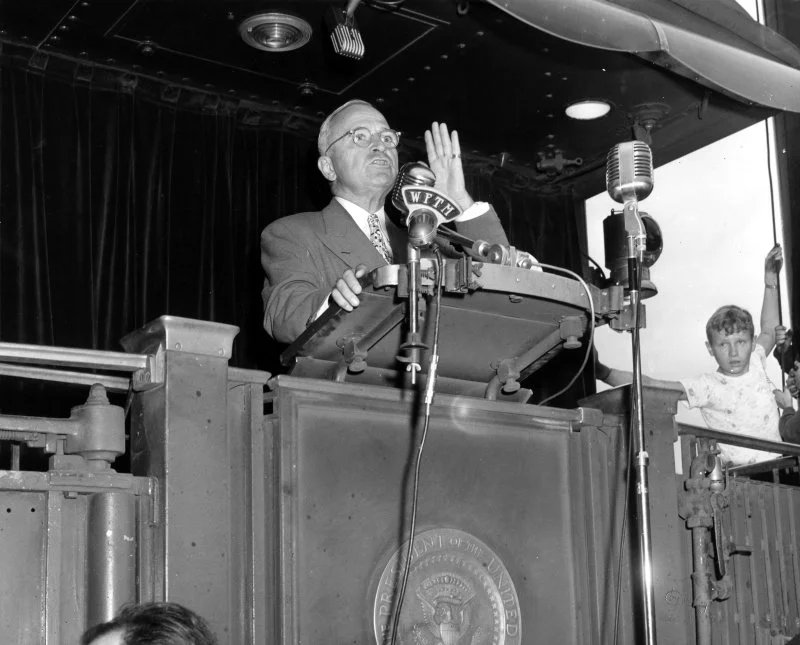
An unusual source for political information, the National Railroad Hall of Fame (NRRHOF) website describes this traditional way of campaigning: traveling by train from one small town to the next, stopping to speak directly with voters. Even today, such efforts may better connect candidates and voters than the wildest AI hallucination. On the NRRHOF site, you can even hear some of the speeches made by President Truman and other dignitaries, as well as see pictures of some of our earlier Presidential candidates campaigning this way.
Dubbed whistle-stop campaigns, the term derives from the description of railway stations in small towns, where trains would stop only if, after blowing their whistles as they approached the town, the engineer then saw a visible signal raised on a tower. Though popularized by President Harry Truman’s underdog but ultimately successful 1948 reelection bid, long whistle-stop campaigns date back to President Theodore Roosevelt’s successful run for President in 1900. Going back even further, the tactic of giving brief campaign speeches from the rear platforms of trains can be traced to 1836, not long after the invention and development of the iron horse. Our ninth President, William Henry Harrison, who died in office only a month into his term, was the first candidate to use a train for this purpose.
Reaching Rural Voters
One significant advantage of a whistle-stop campaign is that it enables a candidate to reach voters in small towns and rural areas, constituencies often overlooked in favor of more densely populated locales. Additionally, the impact reaches far beyond the people who hear these brief speeches in person, owing not only to the word-of-mouth sharing of experiences, but to extensive press coverage. Despite more sophisticated methods of targeting and reaching potential voters today, many in more rural areas still feel their voices and needs are largely ignored by politicians.
Voters often respond to sincerity in candidates, and this extensive study details the types of approaches and arguments that do and don’t work with the electorate. One key finding revealed that the espousing of extreme positions by candidates tends to be counterproductive. Powered by the explosion of largely negative advertising from Independent Expenditure groups (IEs), who can throw unlimited funds into them, political campaigns are, for many Americans, loud, obnoxious, alienating affairs whose ends can’t come soon enough.
The Symbolism of Campaigning by Rail Still Exists
Though used far less frequently these days, many Presidential candidates still campaign by rail, at least for symbolic purposes. Some campaigns embrace similar techniques, such as flying into numerous small airports to hold multiple rallies in a single day. At the same time, rural towns rarely have airports nearby, meaning that air travel by a politician is not actually a substitute for going by rail. But given the woeful state of America’s railway system, particularly when compared with those of other countries, and considering more contemporary ways of reaching voters, a large-scale return to campaigning by rail seems unlikely. Additionally, campaign consulting firms find producing political commercials and purchasing airtime for them far more profitable.
But whistle-stop campaigning in today’s political climate could serve the needs of both candidates and voters alike. Considering that wealth does not typically consolidate among the populations of rural towns, voters in those areas would benefit from meeting directly with politicians to speak about the financial challenges they face, and candidates would do well to understand the needs of their constituents. Remarkably, considering the pervasiveness of people’s economic struggles, not just in small towns but throughout the country, many Senators and Representatives seem unaware of how difficult it is for average Americans just to get by, never mind plan for the future. Many lawmakers just don’t get the level of economic pain so many Americans feel, and the toll it takes on them and their families. Instead, lawmakers often take or avoid actions to aid contributors at the expense of the voters.
Part of politicians’ unwillingness to act in the best interests of their constituents is rooted in the privileged lifestyles they lead simply by virtue of holding public office. Aside from high salaries and generous pension benefits that far exceed most in the private sector, lawmakers are also the beneficiaries of free upscale meals, all-expense paid luxury travel, and complimentary hard-to-get tickets to sports and entertainment events, mostly courtesy of their special-interest suitors.
Some politicians also benefit from confidential briefings they obtain in the course of their official duties. Despite repeated unsuccessful attempts to ban this unsavory practice, Members of Congress can still trade individual stocks. Many leave office far wealthier than when they arrived. For meaningful reforms to occur, it will likely take new generations of lawmakers with higher ethical standards, who understand the economic pain many in the country feel.
Summing It Up
While a return to the rails for large-scale campaigning may not be realistic today, the need for more direct contact with voters on a more personal level remains. This could be done at smaller events, or perhaps even by addressing constituents honestly and openly through the camera, speaking to them directly. Such practices would benefit candidates and voters alike by addressing the sincerity issue, and by getting serious about solving our nation’s major problems, so many of which have gone unaddressed for far too long.
Did You Know…?
A partial list of Presidential candidates who conducted whistle-stop campaigns includes:
• William Jennings Bryan (1896)
• Theodore Roosevelt (1912)
• Woodrow Wilson (1912)
• Robert F. Kennedy (1968)
• George H. W. Bush (1992)
• Barack Obama (2008)
• Joe Biden (2020)
In 1964, First Lady Claudia Johnson also embarked by herself on a four-day, 47-town tour to rally support for her husband, President Lyndon Johnson. Dubbed the “Lady Bird Special” after the nickname of the First Lady, the train covered 1,682 miles from Washington, D.C. to New Orleans.