
Government Living
Beyond Its Means
“When plunder becomes a way of life for a group of men in a society, over the course of time they create for themselves a legal system that authorizes it and a moral code that glorifies it.”
―Frédéric Bastiat
Do As I Say, Not As I Do
Younger people are frequently urged to live within their means. It’s too bad many of our Representatives don't practice the same restraint in managing the nation's finances. For all their oft-expressed concern about the country’s families and children, the actions of many politicians say otherwise as they pile unconscionable levels of government debt onto future generations.
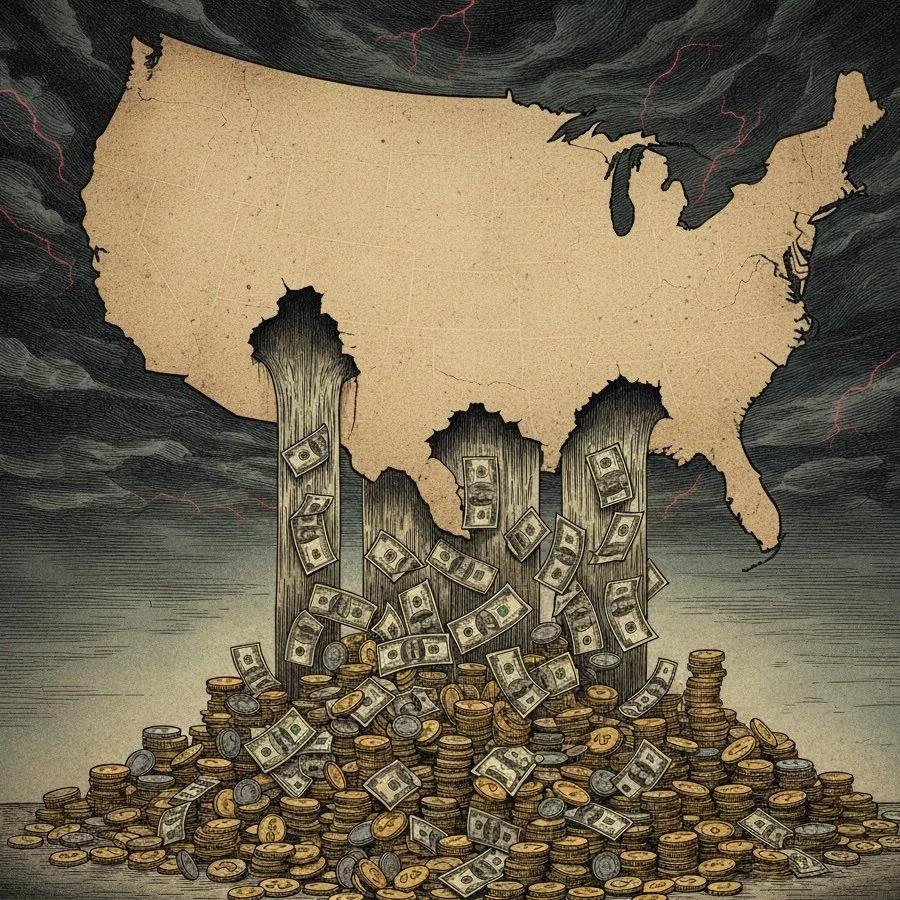
Incredibly, in the 21st Century, the amount the Federal government owes its creditors is measured not in millions or even billions of dollars, but in trillions. Given that the number of people in the country is less than 350 million, that makes each individual citizen’s share of the debt considerable. And for an entire nuclear family, that amount is multiplied by three, four, five, or even more. Where’s the love of family in that?
The public debt of the United States increases by about a million dollars every thirty seconds. The national debt clock is an informative way to see how the fiscal futures of the country in general, and of younger people in particular, are being mortgaged by massive deficit spending. The annual Federal budget from 1969 through 2024 shows a deficit for all but five years. The annual deficit, and consequently the overall debt, has increased substantially in recent years. Although the President initially proposes a budget, Congress must share the blame for this fiscal malfeasance; it is their Constitutional job to fund the government. The consequences of this tremendous debt will fall primarily on younger people, who will have to finance it, along with raising taxes or cutting spending, or both.
Interestingly, most State and Local governments are required to balance their annual budgets. When they are unable to do so—which can happen because of extraordinary circumstances, such as the need for increased spending to combat the COVID-19 pandemic—they resort to short-term borrowing, selling bonds, and other such measures. What they do not do is write a check now for which their children or grandchildren will have to pay.

When lawmakers are unwilling to make the difficult decisions necessary to balance budgets, they often resort to budgetary gimmicks, such as overly optimistic revenue projections or so-called magic asterisks, notations that assume a particular amount of savings or revenue, but with no specified means of achieving it. Basically, it’s Congress’s way of saying, “We'll figure it out later,” even though they never do. The nonprofit, nonpartisan Committee for a Responsible Federal Budget numerous gimmicks Congress utilizes in completing an unbalanced Federal budget.
Stealing from Our Children, Their Children, Their Children’s Children...
As irresponsible as our government overspending is, it’s just one example of the generational theft today’s elected officials practice on a daily basis. While such a characterization may sound harsh, what else would you call it when the current generations burden those of the future, not only spending beyond our means, but also leaving one major problem after another unsolved?
Despite repeatedly being told tax cuts for the wealthy will pay for themselves through increased revenue from greater economic growth, they rarely, if ever, do. We need to start caring about such things if we want a truly healthy economy, one that’s not essentially running on a sugar high, leaving the bills to come due for future generations.
But deficit-spending is not the only long-term threat to our economy. Consider the following ongoing issues, about which we should all be concerned.
Underfunded Pension Liabilities
First, let’s go over some pension basics. Even if you are a younger person, this is still important to you, since you’ll eventually want to retire and be adequately prepared for it. There are two basic kinds of retirement plans: defined-benefit pensions, where you get a lifetime fixed monthly payment once you stop working, and 401K-type plans, where you and your employer contribute to provide a one-time lump-sum payment when you retire. Defined-benefit plans used to be the norm, but most private-sector employers have ditched them for the less costly 401K-style alternatives.
Defined-benefit pensions usually work out better for workers, since they are guaranteed a predictable amount of income no matter how long they live. Though now rare in the private sector, such plans remain common in the public sector, which helps make government employment more attractive. Unfortunately, some government bodies have promised retirement benefits without sufficient means of funding them. Such practices may require using funds from their operating budgets to remain solvent, which in turn increases future deficits. When a private-sector company cannot meet its pension obligations, a government agency called the Pension Benefit Guaranty Corporation usually covers at least part of their obligations. When a government agency’s retirement plan is underfunded, they're on the hook for making it whole again. If they can't do so, they must raise plan contributions from employees, cut benefits, or both. Mostly though, they just kick the can down the road, which is why underfinanced government pensions are both a serious problem today and a threat to future generations.
Did You Know…?
As of September 2026, what is the current national debt?
A) $1 trillion ($2900 per person)
B) $10 trillion ($29,000 per person)
C) $20 trillion ($58,000 per person)
D) $40 trillion ($116,000 per person)
You can find the correct answer at the bottom of this page.

The Student Debt Bomb
For a long time in this country, the parents of one generation felt that life would be better for the next. Lately though, polls show that’s no longer the case. Some of this increasing pessimism may be attributable to the high level of debt many students now carry. The total amount of student debt in the U.S. has reached record levels.
Given these debt loads, which are usually not dischargeable even in bankruptcy, many students wonder when, or even if, they will ever be able to pay them off. Such concerns make some question if a college education is really worth the cost. For students in professional schools, such as medical school or law school, the problem is even worse. This table breaks down the average debt that students entering different professions owe. While there have been some recent Federal government actions to forgive student debt, other efforts have been overturned by the Supreme Court.
Underfunded Infrastructure Needs
When it comes to underfunding public infrastructure needs, the U.S. is truly a world leader, and not in a good way. If you’ve traveled abroad, you’ve probably seen comparative signs of this infrastructure gap. Faster, cleaner, more usable, and more luxurious options for railway travel are common in other countries, as are more modern airports and countless other public facilities.
Such gaps often extend beyond physical infrastructure. Though the U.S. spends far more on health care than other countries do, we are one of the few that don't guarantee coverage for all its citizens. We also pay far more for prescription drugs than people do in other countries, even though American companies own or manufacture many of these drugs.

Summing it Up
Many politicians have long preached major falsehoods about budget deficits and tax cuts. The first is that budget deficits don't really matter. That might be true if you don't believe that these costs will have to be paid back someday.
The second piece of political fiscal deception is that tax cuts pay for themselves by generating more tax revenue for the government through greater economic growth. Unfortunately, they almost never do, for understandable reasons.
For both economic and moral reasons, we need to stop this generational theft. It’s time to elect new generations of lawmakers who more concerned about the nation’s fiscal health than in improving their career prospects by peddling fishy fiscal fabrications.
Answer to the Did You Know…? Question
The answer is D) $40 trillion ($116,000 per person).
This answer is as of September 2026, and is sourced from the U.S. Department of the Treasury. It means that the share of the national debt for a family of five is well more than half a million dollars.
One of the worst legacies of our modern American government is the incredible amount of public debt it has left to future generations. For all the rhetoric many politicians express about taking care of children, leaving them massive amounts of public debt is a terrible way to show it.