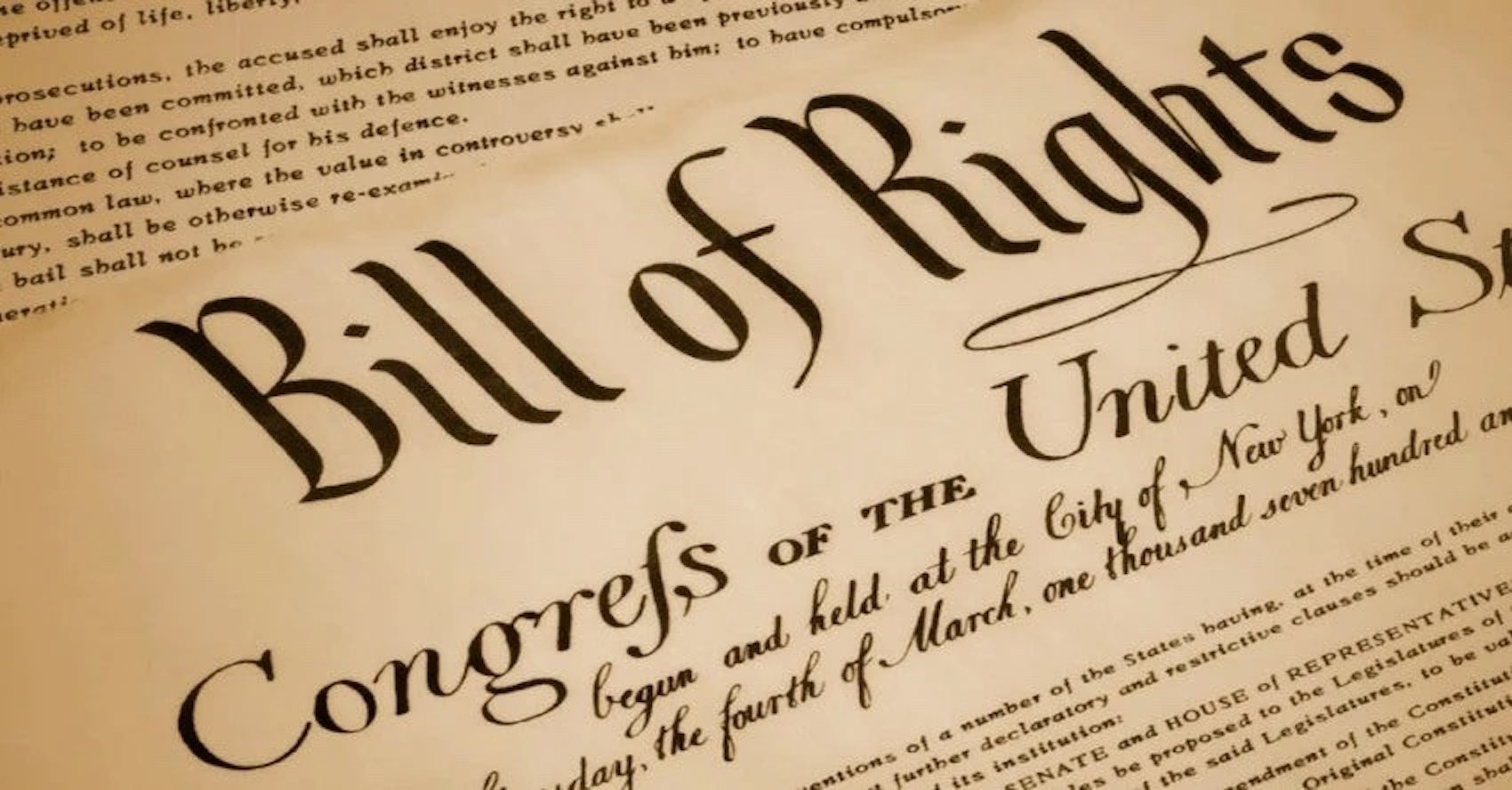
Bill of Rights
““Those who would give up essential Liberty, to purchase a little temporary Safety, deserve neither Liberty nor Safety.”
— Benjamin Franklin
Overview
Prior to the ratification of the Constitution in 1788, its passage was in doubt. On one side of the hotly contested debate, the Federalists believed that the Constitution, as written, provided the government with specific, limited powers, and that it therefore could not abuse individual rights over which it had no authority. Opposed to this view and to ratification, the Anti-Federalists feared that a strong central government, like the British system from which America had declared its independence, would be able to abuse its citizens. The Anti-Federalists refused to support passage of the Constitution without assurances that it would detail explicit protections for the rights of individuals.
This deadlock was resolved by the Massachusetts Compromise. The State agreed to ratify the Constitution with the promise that, once elected, the First Congress would immediately amend the document to specify explicit individual rights. Amazingly, once the two sides agreed, they both fulfilled their parts of the bargain. The Constitution was ratified in June 1788, and during the First Congress, the Bill of Rights was passed in September 1789. Twelve Amendments were proposed and approved, though only ten of those were then ratified by the States. These became the Bill of Rights.
Below are brief descriptions of each Amendment in the Bill of Rights.
The First Amendment prohibits the government from creating or favoring a religion. It also establishes freedom of religion, freedom of speech, freedom of the press, freedom to peaceably assemble and to protest, and the freedom to ask the government to address problems.
The Second Amendment establishes the right to keep and bear arms.
The Third Amendment prohibits the government from forcing people to house soldiers during peacetime, and to be able to do so in wartime only according to established law.
The Fourth Amendment protects people from unreasonable searches and seizures, and demands that warrants be issued only with probable cause.
The Fifth Amendment ensures that people cannot be indicted for a major Federal crime without a Grand Jury first reviewing the evidence and deciding if there is enough to support an indictment. It also protects a person from double jeopardy (being charged for the same crime more than once). It further prevents a person from having to testify against themselves, establishes the right to due process, and the duty of the government to pay a fair and reasonable compensation should it take possession of private property for public use.
The Sixth Amendment establishes the right to a speedy, public, and fair trial, in the jurisdiction where the alleged crime occurred. It also mandates that accused persons be informed of the specific charges against them, that they have the right to confront witnesses against them, that they be afforded the opportunity to obtain witnesses in their favor, and that they have a right to counsel.
The Seventh Amendment ensures the right to a jury trial involving disputes between private properties over money or property. It also prevents Federal Judges and Appellate Courts from overturning a jury’s factual findings on appeal.
The Eighth Amendment prohibits excessive bail, excessive fines, and cruel and unusual punishment.
The Ninth Amendment establishes that the individual rights specified in the Constitution shall not be utilized to deny rights of the people not specified.
The Tenth Amendment specifies that any power not explicitly provided to the Federal government by the Constitution are reserved to the States, or to the people.
You can read more about the Bill of Rights at the National Archives website.
Did You Know…?
The two Amendments passed by Congress in 1789 that were not ratified by the States and so did not become part of the Bill of Rights were the original First and Second Amendments.
The original Second Amendment, known as the Congressional Compensation Amendment, provided that any law changing the compensation of Representatives and Senators could not take effect until an election of the House had taken place. Although it initially failed ratification by the States, it was eventually resurrected and ratified as the Twenty-Seventh Amendment in 1992—more than two hundred years later. No rush!
The original First Amendment, known as the Congressional Apportionment Amendment, mandated that Congress grow along with the country’s population. In particular, it limited the number of citizens that a Representative could serve. With the growth of the population, such an Amendment would have eventually led to a House of Representatives with not 435 Members, but several thousand. While this at first glance might seem crazy, doesn’t it make more sense for a Member of Congress to represent 50,000 or 100,000 people, rather than 761,000, which is the current average?